Why Aren’t Low-Rise Jeans Popular Anymore?
Low-rise jeans never really disappeared in the emotional sense. They stayed alive in memory: on red carpets, in old paparazzi shots, in Y2K mood boards, and in the minds of shoppers who still remember when denim sat low on the hips and felt like the coolest thing you could wear. But memory and market demand are not the same thing.
That is exactly why this topic still matters today. A lot of buyers, boutique owners, and designers are asking the same thing: if low-rise jeans were once so iconic, why are they no longer the default choice for most people? The answer is not just “fashion changed.” It is more practical than that. Consumers changed. Lifestyles changed. Expectations around comfort, body confidence, mobility, and fit became stricter. And denim brands had to respond.
Low-rise jeans are not as popular anymore because most shoppers now prioritize comfort, coverage, versatility, and body confidence over trend nostalgia. While low-rise jeans still exist and are returning in some fashion-forward collections, mid-rise and high-rise jeans remain more practical for everyday wear, easier to fit across different body shapes, and more commercially reliable for brands and retailers.
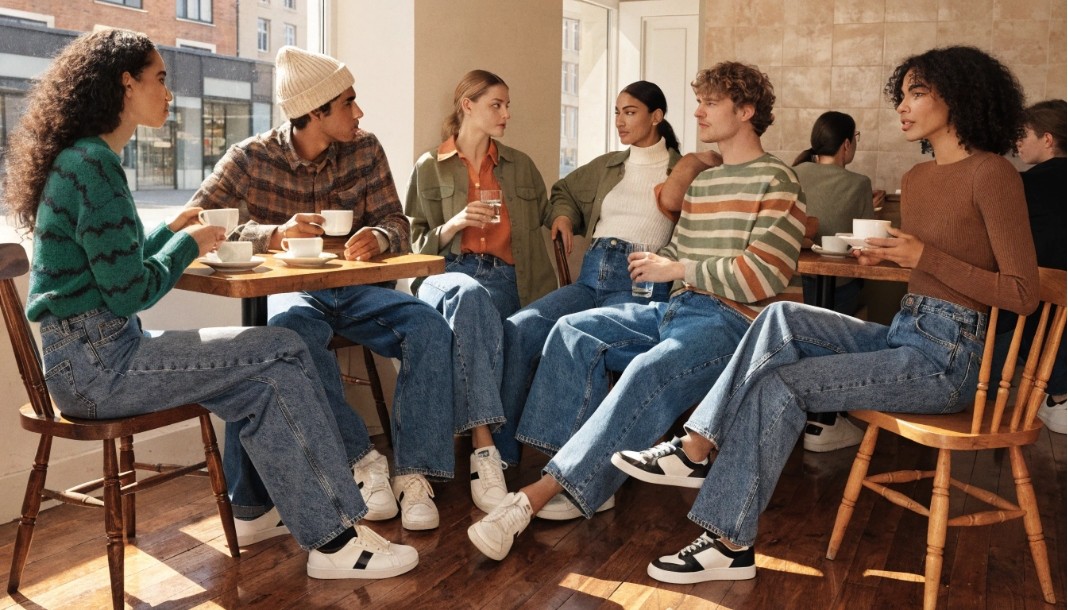
That is what makes this conversation interesting. Low-rise jeans are not simply “good” or “bad.” They are a perfect example of how a fashion trend can be culturally powerful, commercially uneven, and technically difficult all at once. One customer may love the laid-back, sexy, early-2000s attitude. Another may try them on once and immediately say, “No way.” If you have ever watched a shopper light up at the look of low-rise denim, then change their mind the second they sit down, bend over, or check the mirror from the side, you already know the real story starts where the trend photos end. Let’s get into it.
Why did low-rise jeans fall out of fashion in the first place?
Low-rise jeans fell out of fashion because the market shifted toward fits that offered more comfort, coverage, and stability. As denim became more lifestyle-driven, shoppers preferred mid-rise and high-rise silhouettes that felt easier to wear, more flattering across more body types, and less restrictive in daily life.
How did low-rise jeans become a defining Y2K denim trend?
To understand why low-rise jeans lost ground, it helps to remember why they became so big in the first place. In the late 1990s and early 2000s, fashion leaned hard into youth culture, celebrity influence, and body-baring silhouettes.
Denim was not just casualwear. It was status, attitude, and identity. Low-rise jeans fit that moment perfectly. They looked rebellious, sexy, and a little risky. They also photographed well, which mattered in the peak tabloid era.
Back then, denim trends were driven less by practical fit questions and more by image. The waistband sitting below the waist created a very specific silhouette. It exposed more of the torso, lengthened the appearance of the upper body for some wearers, and paired naturally with baby tees, cropped tops, and fitted jackets. In trend terms, it made total sense.
But the very reasons low-rise jeans became popular also contained the seeds of their decline. A silhouette built around exposure and aesthetic tension tends to be less forgiving in real life. It can feel exciting in a styled photo and inconvenient in daily wear. Once fashion moved away from that specific Y2K mood, low-rise jeans had less functional value to fall back on.
Why don’t they make low-rise jeans anymore?
This is one of the most searched questions on the topic, and the short answer is: brands still make them, just not at the same scale. The bigger issue is not total disappearance. It is reduced priority.
Brands produce what sells consistently. Mid-rise and high-rise jeans have been stronger commercial bets because they work for more shoppers, more occasions, and more styling needs. Public trend coverage for spring 2026 shows low-rise jeans are still present, but they are part of a broader denim mix rather than the dominant default. Vogue’s spring 2026 denim roundup explicitly includes low-rise among current trends, but alongside baggy, bootcut, and other revived fits, which signals variety rather than one-silhouette dominance.
From a manufacturing and merchandising point of view, low-rise jeans are also riskier. They are more sensitive to pattern accuracy, hip fit, waistband tension, seat balance, and wearer movement. A small grading mistake in a low-rise style can create obvious discomfort or exposure problems. That means more fittings, more customer hesitation, and often higher return rates if the fit is not dialed in.
So it is not that factories “cannot” make low-rise jeans. Strong denim manufacturers absolutely can. The real question is whether brands want to allocate resources to a fit that is more trend-driven, less universally wearable, and harder to sell as a core product year-round. For many labels, the answer has been: make some, not many.
Why did mid-rise and high-rise jeans take over the mainstream market?
Because they solved more problems for more people.
When shoppers buy jeans today, they are usually thinking beyond one outfit. They want pieces that work for commuting, sitting, walking, eating out, traveling, and repeating across different tops and shoes.
Mid-rise and high-rise jeans generally feel more stable during movement, easier to tuck into, and more versatile for a wider age range and customer base. Multiple fit guides and denim explainers now frame rise not just as a style choice, but as a comfort-and-support decision, especially for long wear.
There is also a merchandising angle here. High-rise and mid-rise jeans work well with a larger variety of leg shapes: straight, skinny, flare, wide-leg, baggy, barrel, and more. Retailers like products that can bridge style cycles without becoming obsolete too fast. A well-made mid-rise straight jean can survive trend swings better than an ultra-low-rise skinny jean tied to a very specific era.
How did changing ideas about comfort, body confidence, and daily wear reshape denim demand?
This may be the biggest reason of all.
Consumers became much more vocal about how clothes feel, not just how they look. People started paying closer attention to practical issues: Does the waistband stay in place? Can I sit comfortably? Do I feel exposed? Can I wear this all day? Those questions hurt low-rise jeans more than they hurt other rises.
At the same time, body confidence conversations changed the market. Shoppers increasingly wanted jeans that supported them rather than challenged them. That does not mean everyone wants the same fit. It means more people want choice, security, and less anxiety in the fitting room. High-rise and mid-rise jeans often deliver that more easily.
For brands and buyers, this shift matters. Denim is not only about trend language anymore. It is also about trust. The jeans have to make the customer feel good quickly. If the customer has to negotiate with the garment, adjust it constantly, or style around its weaknesses, most of the market will move on.
Are low-rise jeans less flattering and comfortable for most people?
For most shoppers, low-rise jeans are harder to fit comfortably because they provide less coverage and less waistband security. They can still look great on the right proportions and in the right cut, but they are generally less forgiving than mid-rise or high-rise jeans for all-day wear.

What is the problem with low-rise jeans?
The “problem” with low-rise jeans is not that they are automatically bad. It is that they ask more from both the garment and the wearer.
A low-rise jean sits closer to the hips, which means it depends heavily on precision through the hip, seat, crotch curve, and waistband tension. There is less vertical coverage to stabilize the garment. So if the pattern is slightly off, the wearer feels it right away. Sliding, digging, gaping, overexposure, and awkward pulling are all common complaints.
This is why low-rise jeans often divide people. Some wearers experience them as cool, relaxed, and body-skimming in a flattering way. Others experience them as stressful. Same category, very different outcome.
Why do many shoppers feel less secure in low-rise jeans?
Because security in denim is partly structural. A higher rise anchors the jeans closer to the natural waist. A low rise anchors lower, which means the garment has less upper-body support and more dependence on hip grip. That can feel fine when standing still. It can feel much less fine when sitting, crouching, reaching, or moving through a long day.
A recent comfort comparison notes that low-rise jeans may reduce upper abdominal pressure, but they are also more prone to shifting downward and creating strain around the crotch and hip area when seated. By contrast, higher rises can distribute tension more vertically if cut with enough ease.
That everyday instability is what many customers react to. They are not always saying, “I hate the look.” They are often saying, “I do not trust this fit.”
How do low-rise jeans compare with high-rise jeans in support, coverage, and ease of movement?
Here is the simplest way to explain it:
| Feature | Low-Rise Jeans | Mid/High-Rise Jeans |
| Waist coverage | Lower | Moderate to high |
Sitting comfort | Can shift or pull if fit is off | Usually more stable |
Styling mood | Trend-driven, Y2K, fashion-forward | Versatile, mainstream, easier daily wear |
| Fit tolerance | Low | Higher |
| Commercial reach | More niche | Broader customer appeal |
This table reflects what buyers and wearers keep discovering in practice: low-rise jeans can absolutely work, but they usually require more careful patterning, more intentional styling, and more selective customer matching.
Public fit explainers consistently frame high-rise and mid-rise jeans as more supportive and easier to integrate into daily wardrobes, while low-rise is often treated as more fashion-specific.
Why do low-rise jeans work for some body proportions but not for everyone?
Because rise interacts directly with torso length, hip shape, seat depth, and how a person likes their clothes to sit. There is no single “best” rise for every body.
Some people with longer torsos or straighter hip lines feel great in low-rise jeans because the lower waistband does not interrupt their proportions awkwardly. On the other hand, many curvier customers, short-torso customers, or anyone who wants more containment around the midsection may find low-rise less comfortable or less flattering.
This is exactly why brands that sell low-rise jeans successfully do not just market the vibe. They get technical. They talk about stretch level, top-block balance, waistband engineering, and leg silhouette. A low-rise baggy jean is not the same experience as a low-rise ultra-skinny jean. The rise may be similar, but the wearing experience is not.
So are low-rise jeans less flattering and comfortable for most people? In the broad mass-market sense, yes, often they are. But in a well-designed style for the right customer, they can still be excellent. The key is not pretending they are universal.
Are low-rise jeans actually coming back in style, or are they still a niche trend?
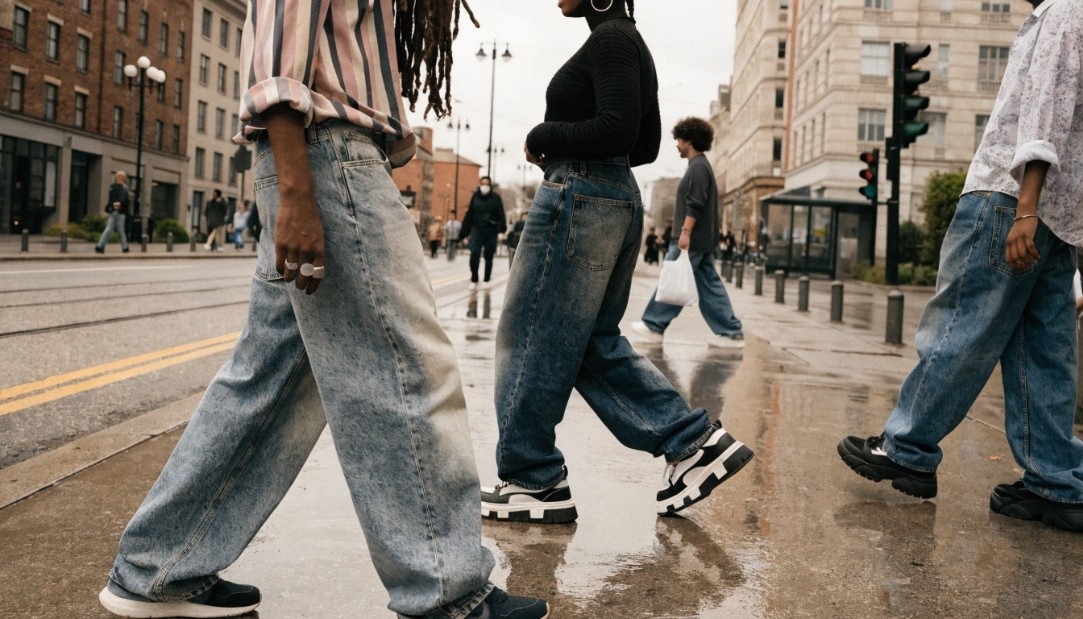
Low-rise jeans are coming back, but mostly as a selective fashion trend rather than a full mainstream takeover. In 2026, they are showing up in trend reports and street style, especially in baggy and relaxed cuts, yet mid-rise and high-rise jeans still dominate everyday denim shopping.
Are low-rise jeans still in style?
Yes, but with an important asterisk.
They are in style in the sense that fashion editors, trend watchers, and some consumers are paying attention to them again. They are appearing in curated trend lists, celebrity looks, and Y2K-inspired styling. Spring 2026 fashion coverage from Vogue includes low-rise denim as one of the season’s notable jean directions. Who What Wear also recently highlighted a celebrity airport look built around low-rise baggy jeans, which shows the silhouette is still visible in style media.
But “in style” does not automatically mean “widely adopted.” Plenty of trends receive editorial attention without becoming core wardrobe staples for the average buyer. That is exactly where low-rise sits right now: relevant, visible, but still selective.
Are low-rise jeans coming back in 2026?
Yes, they are coming back in 2026, but not as a pure replay of the early 2000s.
That distinction matters. The modern return of low-rise denim is not mainly about ultra-tight, ultra-revealing jeans. It is more often connected to baggy fits, relaxed silhouettes, and styling that feels looser and more wearable. Vogue’s 2026 denim trend coverage places low-rise within a wider field of revived fits, while recent style reporting shows low-rise paired with oversized tees, laid-back layers, and less aggressive body-conscious styling.
So yes, low-rise is back. But it is back in a softened, edited, commercially smarter way.
Why are modern low-rise jeans returning in baggy, relaxed, and wide-leg silhouettes instead of ultra-tight Y2K versions?
Because the market learned something.
Consumers may enjoy nostalgia, but they still expect comfort. A low-rise baggy jean gives some of the Y2K attitude without forcing the body into the most unforgiving version of the silhouette. It creates ease through the hip and leg, reduces tension, and lets the waistband feel intentional rather than punishing.
This is a very important signal for brands and product developers. When a trend returns, it rarely returns unchanged. It comes back filtered through current customer expectations. In 2026, those expectations still include movement, comfort, and versatility. That is why relaxed low-rise jeans have more room to succeed than the skin-tight versions many people remember from the past.
If low-rise jeans are back, why are they still not dominating denim like mid-rise and high-rise fits?
Because visibility is not the same as volume
Trend media can make a silhouette feel bigger than it is. A few runway moments, a few celebrity outfits, and a few fashion-editor favorites can create strong buzz, but the mainstream denim market still runs on repeatability. Most shoppers want jeans that are easy to buy, easy to wear, and easy to recommend. Mid-rise and high-rise still win that test more often.
Low-rise also depends more heavily on styling context. It often works best when the rest of the outfit is intentional. The right top length, the right outerwear proportion, the right hip fit, the right inseam break. That makes it exciting for fashion-minded shoppers, but less automatic for the wider market.
For boutiques and private-label brands, this creates a very useful strategy lesson: low-rise jeans can be a smart addition to the assortment, especially when linked to trend-led customers, creators, and younger audiences. But they are usually stronger as a curated item than as the single backbone of a denim program.
Who should wear low-rise jeans, and how can they choose the right fit?
Low-rise jeans tend to work best for shoppers who like a lower waistband placement and are comfortable styling around it. The right fit depends less on trend and more on torso length, hip shape, fabric, and leg silhouette. A good low-rise jean must feel secure without digging or sliding.

What body types or torso proportions tend to suit low-rise jeans best?
Low-rise jeans often work well for people with longer torsos, straighter hips, or shoppers who simply prefer less fabric over the midsection. They can also appeal to wearers who like their tops to drape over the waistband rather than tuck in.
That said, this is not a strict rule. Plenty of curvy shoppers wear low-rise jeans successfully when the pattern is right and the fabric has the right balance of hold and flexibility. The better approach is to stop asking, “What body type is allowed to wear this?” and start asking, “What top block and rise placement feel best on this customer?”
That shift is especially important for brands. Selling denim through rigid body-type stereotypes is outdated. Selling through fit logic is far more helpful.
How can shoppers avoid common fit issues such as waistband gaping, hip tightness, or overexposure?
The answer starts at the pattern level and finishes at the try-on stage.
First, the waistband must hug without crushing. A low-rise jean that is too loose will slide. One that is too tight will dig into the hips and distort the front rise. Second, the seat and crotch curve need enough depth to allow movement. Third, the leg silhouette matters more than many people think. A slightly looser thigh and leg can make a low rise feel much easier to wear.
For shoppers, there are a few practical rules:
Walk, sit, and bend before judging the fit.
Check the side view, not just the front mirror angle.
Pay attention to where the waistband lands on your body, not just the product label.
If you keep pulling them up, they are probably not the right pair.
For brands and boutiques, this is where better product education helps. A customer-centered fit description can reduce disappointment fast.
What rise measurement actually counts as low-rise in today’s denim market?
Most general fit guides place low-rise jeans around the 7 to 8 inch front-rise range, though this can vary by brand, size, and category. Some also describe low-rise as sitting roughly 2 to 3 inches below the navel.
This matters because “low-rise” is not always consistent across brands. One brand’s low-rise may feel almost mid-rise on another customer. That is why serious buyers should not rely on labels alone. They should ask for technical measurements, fit samples, and clear rise specs.
For OEM and ODM development, this is even more important. If a brand wants a low-rise style, the factory should confirm:
front rise
back rise
waistband shape
hip circumference
seat depth
stretch content
intended styling silhouette
That level of detail is what separates a fashionable product from a return problem.
What fabric, stretch level, and pattern details make low-rise jeans easier to wear?
Low-rise jeans usually perform best when the fabric and pattern are designed to support the lower placement of the waistband.
Helpful features include:
denim with controlled stretch for flexibility without collapse
a well-shaped waistband that follows the hips
enough back rise to prevent pulling when seated
a balanced crotch curve for movement
a leg shape that matches the intended top-block fit
A rigid 100% cotton low-rise jean can look amazing, but it needs excellent pattern work. A comfort-stretch version can be easier for wider customer adoption. Neither is automatically better. It depends on the target wearer and brand positioning.
This is where an experienced denim manufacturer becomes valuable. Low-rise jeans are not impossible to make. They just leave less room for guesswork. For buyers who want custom development, detailed fitting support is not optional. It is the product.
How can brands and buyers style low-rise jeans in a more modern and wearable way?
To make low-rise jeans feel modern, pair them with balanced silhouettes such as relaxed shirts, cropped jackets, fitted knits, or oversized basics. In 2026, the most wearable low-rise looks are less about extreme exposure and more about proportion, ease, and confident styling.

How can low-rise jeans be styled in a polished, updated way instead of looking dated?
The easiest mistake with low-rise jeans is styling them too literally. If the whole outfit looks like a costume from 2003, the result can feel nostalgic in the wrong way. The better move is to mix the lower rise with more current proportions.
Think:
low-rise baggy jeans with a clean fitted tank and structured blazer
low-rise straight jeans with a relaxed button-down and sleek belt
low-rise denim with a cropped jacket that ends intentionally, not awkwardly
simple shoes and minimal accessories that let the silhouette speak
Modern styling is less about showing more skin and more about controlling shape.
What tops, jackets, and footwear make low-rise denim feel more wearable in 2026?
The best pairings in 2026 tend to create balance.
Relaxed tees, crisp shirts, light knits, cropped bombers, denim jackets, and softly structured outerwear all work well. Footwear can push the look in different directions: sneakers for casual ease, pointed flats for polish, boots for structure, or minimal heels for a cleaner fashion finish.
Recent coverage showing low-rise baggy jeans in travel style is a good reminder that the silhouette works best when it feels effortless rather than overworked.
For boutiques, this means the styling story is part of the product story. Low-rise denim sells better when customers can instantly see how to wear it.
How should boutiques and denim brands market low-rise jeans to modern customers?
By being honest and specific.
Do not market low-rise jeans as “for everyone.” That weakens trust. Instead, present them as a style option with a clear mood and a clear fit profile. Use language like:
relaxed Y2K-inspired shape
lower-waist fit with modern leg volume
best for customers who prefer a low hip placement
designed for styling with cropped or easy untucked tops
This approach respects the customer. It tells them what they are buying without overselling universality.
Brands should also show the jeans on multiple body shapes and in motion, not only in static front-facing photos. Low-rise denim lives or dies on real-life fit.
Should brands position low-rise jeans as a core bestseller or as a trend-driven seasonal option?
For most brands, low-rise jeans are better positioned as a trend-driven or niche-core item rather than the single main bestseller. They can perform well in the right collection, especially for younger audiences, boutique drops, influencer-led capsules, and fashion-forward seasonal programs. But for broad commercial stability, mid-rise and high-rise still provide stronger year-round volume. Current 2026 trend coverage supports the idea that low-rise is relevant, but as part of a mixed denim landscape rather than the undisputed center of it.
That does not reduce their value. In fact, it sharpens it. A smart brand does not need every fit to serve every customer. It needs each fit to serve the right customer well.
Final Thoughts: Low-Rise Jeans Are Not Dead. They Are Just More Selective Now.
Low-rise jeans are not unpopular because people suddenly forgot how fashionable they once were. They are less dominant because modern customers ask more from their denim. They want comfort, movement, confidence, versatility, and fit consistency. Low-rise jeans can still deliver style, edge, and trend relevance, but they do not solve as many everyday problems as mid-rise and high-rise options do. That is the real answer.
For brands, boutique owners, and designers, this creates an opportunity. The denim market does not need fewer choices. It needs better-made choices. A low-rise jean can absolutely succeed in 2026, but only when it is developed with intention: the right rise, t
If you are building a denim line and want to develop custom low-rise jeans, baggy jeans, stacked jeans, straight jeans, selvedge jeans, skinny jeans, jogger jeans, denim jackets, denim shorts, or denim shirts, DiZNEW can help bring your concept to life. With over 20 years of experience in denim R&D, manufacturing, and OEM/ODM production, DiZNEW supports everything from small-batch MOQ 30 pieces to large-volume orders up to 10,000 pieces, including complex wash details, pattern development, branding, and logo customization.
Whether you are a denim designer, boutique owner, private label brand, or online fashion seller looking for a reliable Chinese jeans factory, now is a great time to turn your ideas into real products.
Send your inquiry to DiZNEW today and start developing your next custom denim collection with a manufacturing partner that understands both trend direction and technical fit.
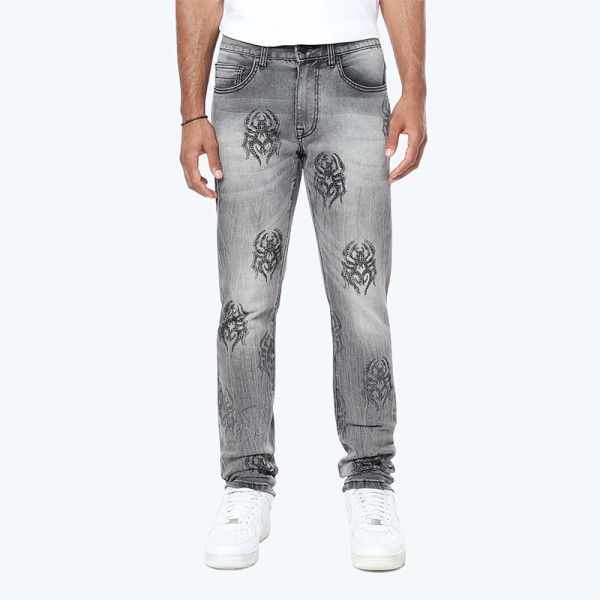
Classic gray denim meets edgy tribal flame embroidery for a bold, confident streetwear vibe.
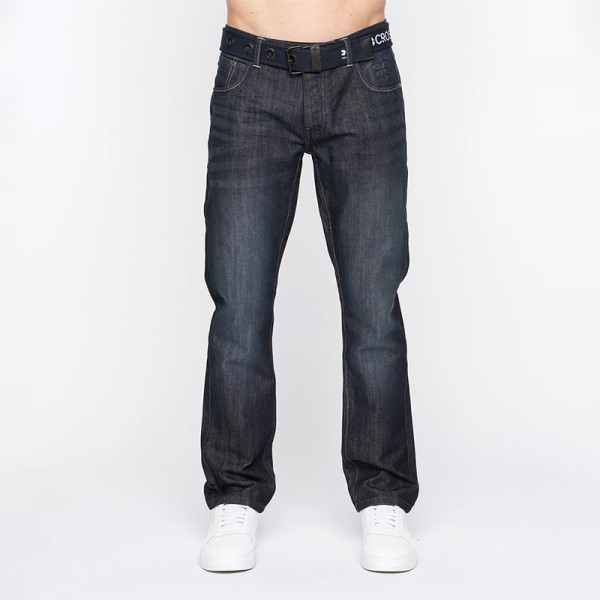
Tailored straight-leg dark jeans with clean lines, custom-made for boutique and luxury labels.
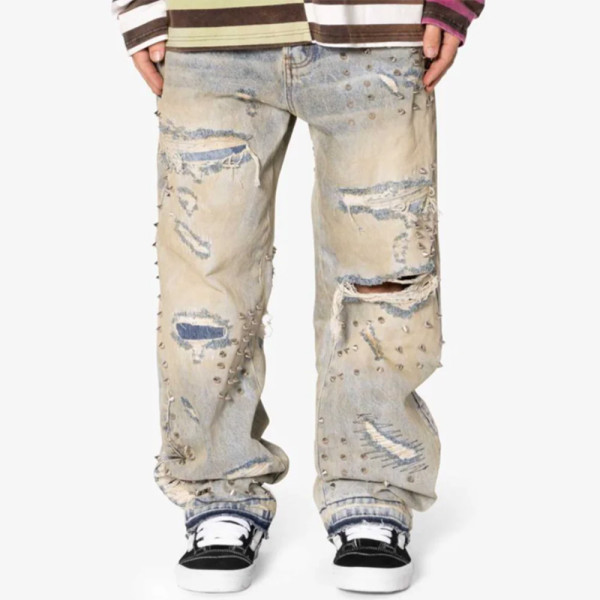
Extreme distressed baggy jeans with stud details—perfect for bold boutique lines & edgy designer labels.
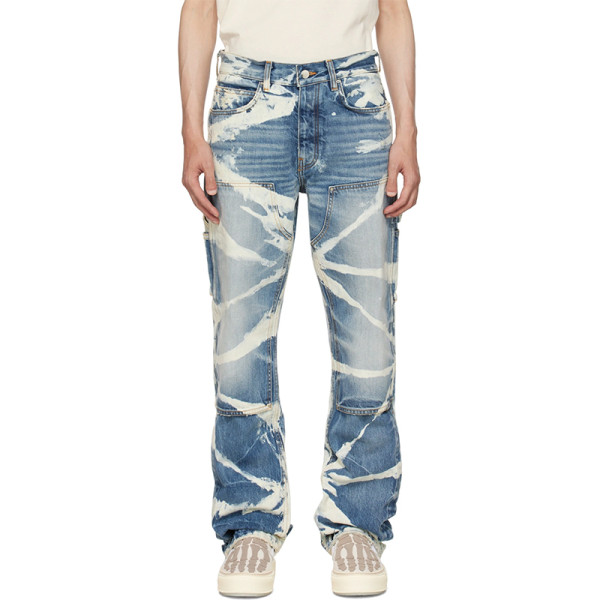
Striking bleached tie-dye jeans made for custom orders, ideal for upscale streetwear and boutique designers.