why buy 100 cotton jeans
For a long time, jeans were simple: cotton, indigo, metal buttons, strong seams, and a fit that became better the more you wore it. Today, however, the denim market is much more complicated. A boutique owner may look at a sample tag and see 98% cotton with 2% elastane. A designer may request “premium vintage denim” but also want comfort like yoga pants. A private-label brand may wonder whether customers will still buy rigid jeans when stretch denim is everywhere. So the real question is not just “Are 100% cotton jeans good?” The better question is: Are 100% cotton jeans the right product for your brand, your customer, and your price positioning?
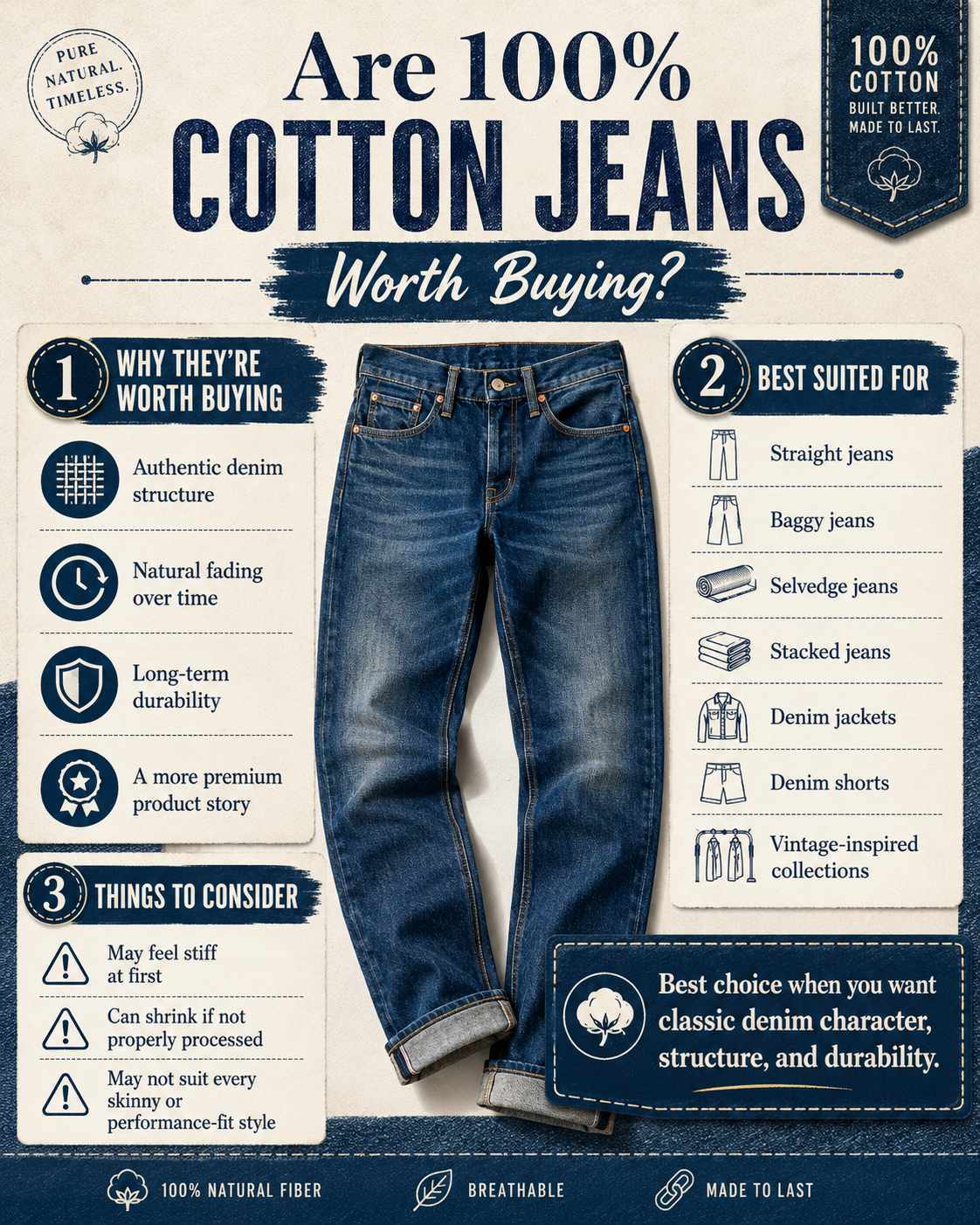
100% cotton jeans are worth buying when you want authentic denim structure, natural fading, long-term durability, and a more premium product story. They are especially suitable for straight jeans, baggy jeans, selvedge jeans, stacked jeans, denim jackets, denim shorts, and vintage-inspired collections. However, they may feel stiff at first, can shrink if not properly processed, and may not suit every skinny or performance-fit style.
Imagine two jeans hanging in the same boutique. One feels soft and stretchy the second you touch it. The other feels firm, textured, and almost old-school. The first sells comfort immediately. The second sells character, craftsmanship, and long-term value. The smartest brands are not choosing blindly between them. They understand when 100% cotton denim creates stronger emotional value—and when a blended fabric may be the better business decision.
What Are 100% Cotton Jeans, and Why Are Jeans Not 100% Cotton Anymore?
100% cotton jeans are made from denim fabric woven entirely from cotton yarns, without elastane, spandex, polyester, or other synthetic fibers. Many modern jeans are no longer 100% cotton because consumers now expect softer hand feel, stretch comfort, shape recovery, and easier sizing. Stretch blends help brands create skinny, slim, plus-size, and comfort-focused jeans, while 100% cotton remains popular for authentic, structured, vintage, and premium denim styles.
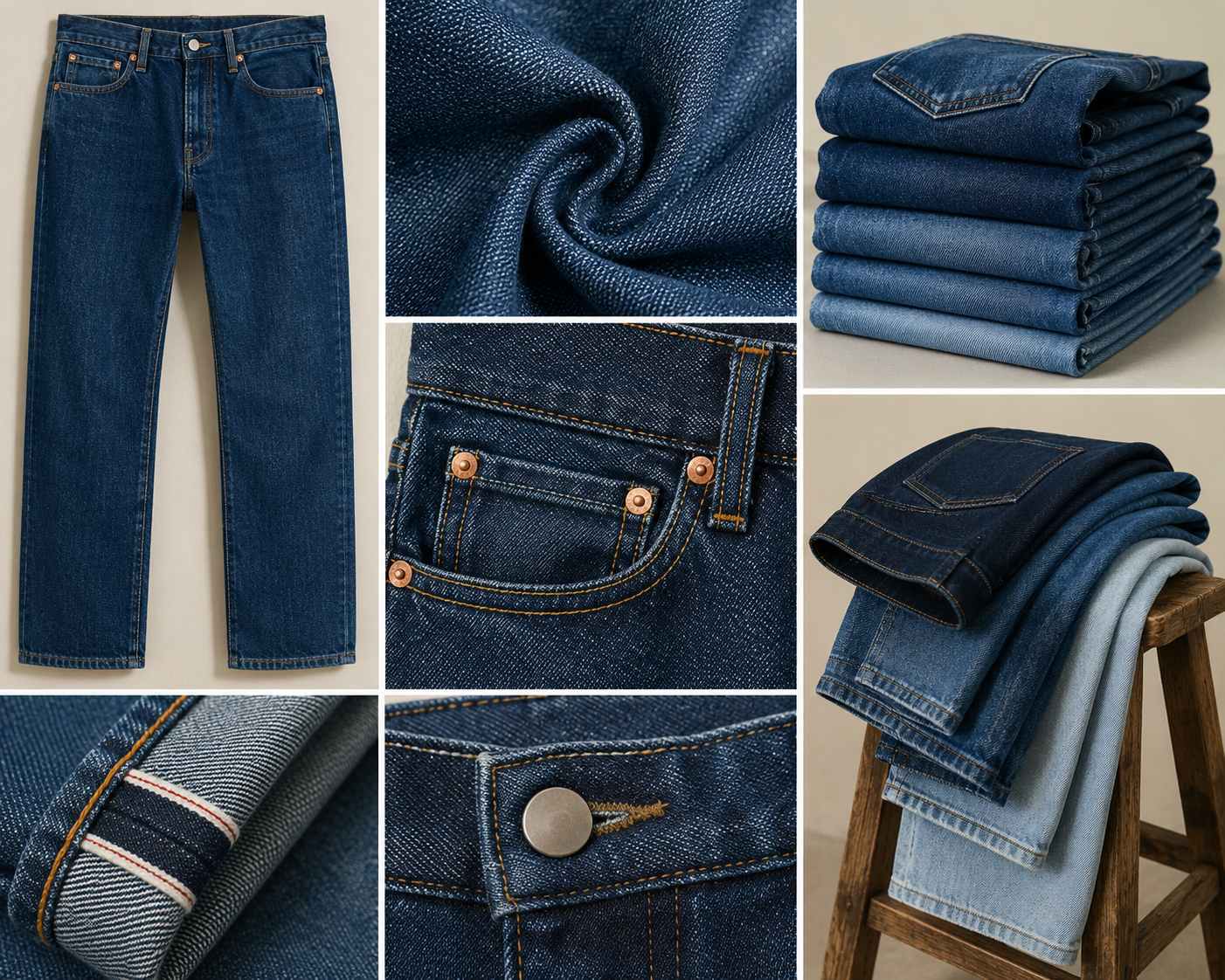
To understand why 100% cotton jeans still matter, we need to look at what denim was originally designed to do. Traditional denim was not created as a delicate fashion fabric. It was developed to be tough, practical, and long-lasting. Cotton denim has a woven structure, usually a twill weave, where the warp yarns are dyed and the weft yarns are often left lighter or undyed. This construction gives denim its familiar surface texture, diagonal lines, and ability to fade in a beautiful, uneven, personal way.
When jeans are made from 100% cotton, the fabric behaves in a more “honest” way. It does not snap back like stretch denim. It does not hug the body with synthetic recovery. It starts with structure, then slowly adapts to the wearer. That is why denim fans often say a good pair of rigid cotton jeans has a break-in period. At first, the jeans may feel firm. After repeated wear, the seat, thighs, knees, and waist begin to mold naturally to the body. This process creates a personal fit that many denim lovers find more valuable than instant softness.
So why are jeans not 100% cotton anymore? The answer is simple: the market changed. Modern customers often want jeans that feel comfortable from the first try-on. They want to sit, drive, walk, squat, travel, and work without feeling restricted. For styles like skinny jeans, jegging jeans, slim jeans, plus-size jeans, and some jogger jeans, adding elastane or spandex can make the product easier to wear and easier to sell. Even 1% to 3% elastane can change the customer experience dramatically by improving stretch and recovery.
But there is a trade-off. Stretch denim may feel better immediately, but it can also lose some of the traditional character that makes denim special. If the fabric has too much stretch or poor recovery, customers may complain about bagging at the knees, sagging at the seat, or losing shape after a few wears. Blended denim can also feel less premium if the fabric is too thin, too soft, or too “legging-like” for a customer expecting real jeans.
For brands, this is not a moral choice between “good” 100% cotton and “bad” stretch denim. It is a product strategy decision. If your customer wants heritage, structure, vintage washes, heavy denim, selvedge details, strong silhouettes, or high-end streetwear, 100% cotton can be a powerful choice. If your customer wants body-hugging comfort, inclusive sizing flexibility, or all-day mobility, a cotton-stretch blend may work better.
Here is a simple comparison:
If you are developing custom jeans for your own label, the important question is not “Which fabric is best?” It is “Which fabric tells the right story to my customer?” A luxury denim customer may happily accept stiffness because they associate it with quality. A mass-market comfort customer may reject the same fabric because it feels too rigid. That is why fabric selection should always begin with target customer, fit, wash, and brand positioning.
What Are the Benefits of 100% Cotton Denim?
The main benefits of 100% cotton denim are authentic texture, strong structure, natural breathability, long-term durability, and better vintage fading. It is ideal for brands that want jeans with a premium hand feel, a classic denim look, and a product story based on craftsmanship. For designers and boutique owners, 100% cotton denim can make jeans feel more substantial, more timeless, and more emotionally valuable to customers.
The biggest benefit of 100% cotton denim is character. Stretch jeans can be comfortable, but 100% cotton jeans often feel more like “real denim” to customers who care about authenticity. When a buyer touches a pair of rigid cotton jeans, they can usually feel the weight, grain, and firmness of the fabric. This physical feeling matters. In retail, customers often judge quality within seconds. A thicker, structured, pure cotton denim can communicate value before the customer even reads the product description.
Another major benefit is fading. Denim is not like a plain T-shirt fabric. It is loved because it changes. With 100% cotton denim, fades usually develop more naturally over time. The high-wear areas, such as the thighs, whiskers, honeycombs behind the knees, pocket edges, hems, and seams, can create unique contrast. This is especially important for raw denim, selvedge denim, vintage washes, and high-end streetwear jeans. A customer who buys 100% cotton jeans may not simply be buying a garment. They may be buying a piece that will tell their own story after months or years of wear.
Durability is another strong selling point. Because 100% cotton denim does not rely on elastic fibers, there is no elastane component that can break down with repeated stretching, washing, heat drying, or chemical finishing. Of course, not all 100% cotton denim is automatically durable. A lightweight 6 oz cotton denim will not perform like a heavy 14 oz denim. Durability depends on yarn quality, fabric weight, weave density, sewing quality, seam construction, washing process, and how the customer wears the jeans. Still, when properly made, 100% cotton denim is a strong option for long-lasting jeans.
For brands, the benefits go beyond fabric performance. 100% cotton denim is easier to explain in marketing. Product pages can use words like rigid denim, vintage-inspired, pure cotton, authentic twill, classic five-pocket construction, premium wash, natural fade, or heritage fit. These phrases help customers understand why the jeans may cost more than a basic stretch pair. If your brand sells to customers who care about craftsmanship, these details matter.
There is also a sustainability angle, but it needs to be explained honestly. 100% cotton denim is not automatically “sustainable” just because it is natural. Cotton farming, dyeing, washing, and finishing all have environmental impacts. However, mono-fiber products can be easier to think about from a circularity and recycling perspective than complex blends. When fabrics combine cotton, polyester, elastane, and other fibers, separation and recycling become more challenging. For conscious brands, 100% cotton can support a clearer material story, especially when combined with responsible sourcing, better washing processes, durable construction, and longer product life.
A good way to think about 100% cotton denim benefits is through customer perception:
| Customer Perception | Why 100% Cotton Helps |
| “These jeans feel premium.” | Firm structure and heavier hand feel can signal quality. |
| “These look vintage.” | Pure cotton denim works well with classic washes and natural fading. |
| “These are real jeans.” | Rigid denim has a traditional look and feel. |
“These will last.” | Strong fabric and no elastic fiber dependency can support durability. |
“This brand knows denim.” | 100% cotton fits heritage and craftsmanship storytelling. |
For boutique owners and online denim brands, this is powerful. Online shoppers cannot touch the fabric, so the product story must do more work. Describing the fabric weight, cotton composition, fit, wash, and break-in expectations can reduce confusion and increase trust. Instead of simply saying “100% cotton jeans,” a better product description might say: “Made from structured 100% cotton denim with a vintage wash and a natural break-in feel. Designed to hold its shape while softening with wear.”
That kind of wording helps the customer understand the value before they buy.
What Are the Disadvantages of 100% Cotton?
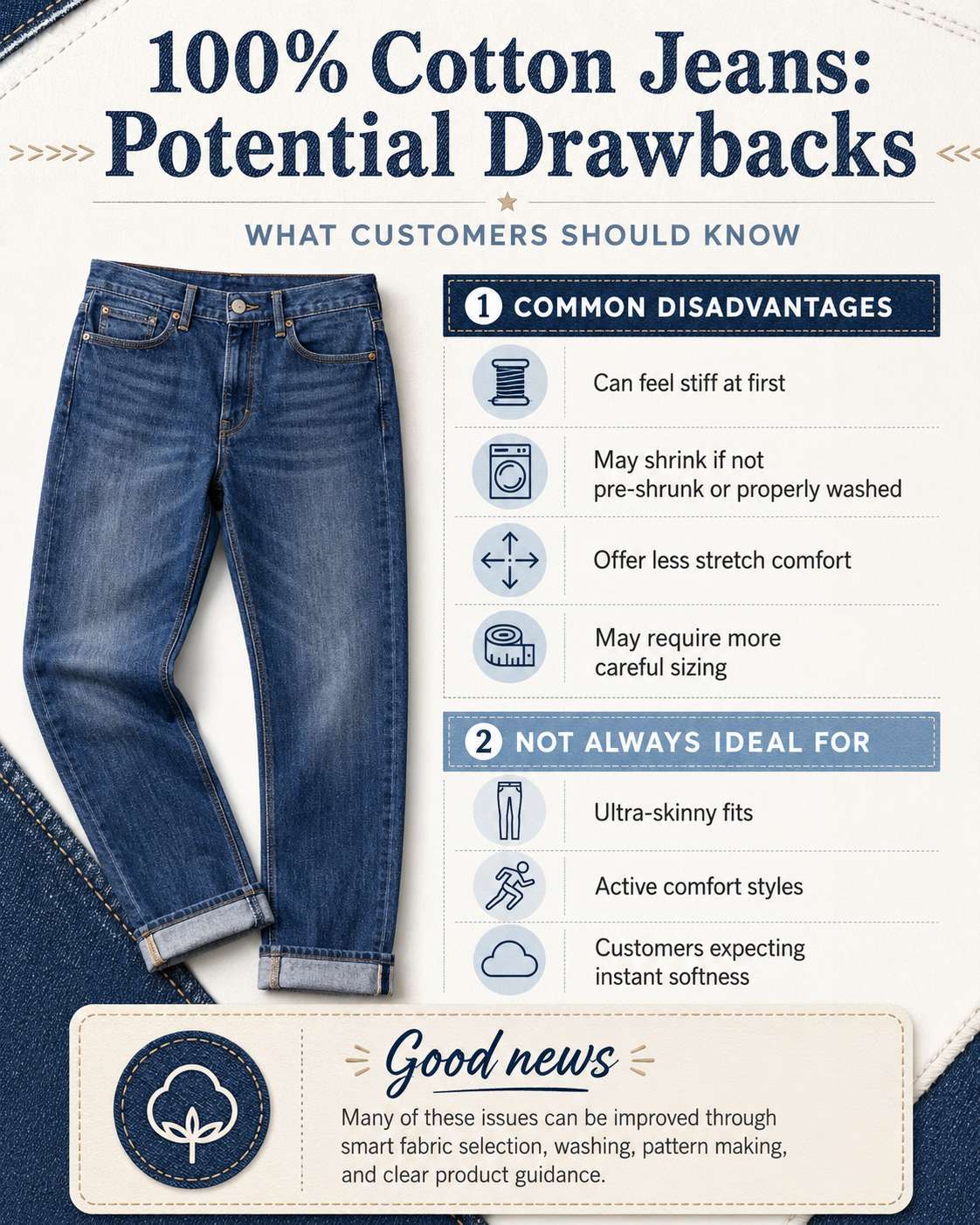
The disadvantages of 100% cotton jeans are that they can feel stiff at first, may shrink if not pre-shrunk or properly washed, offer less stretch comfort, and may require more careful sizing. They are not always the best choice for ultra-skinny fits, active comfort styles, or customers who expect instant softness. However, many of these issues can be solved through fabric selection, washing, pattern making, and clear product guidance.
A professional denim brand should never talk about 100% cotton as if it has no weaknesses. Customers are smart. They read reviews. They compare products. They know that some rigid jeans feel uncomfortable, shrink unexpectedly, or become difficult to size. If you only talk about the benefits and ignore the disadvantages, your product page may sound like advertising instead of expertise. Good content builds trust by explaining both sides.
The first disadvantage is stiffness. Many 100% cotton jeans feel firmer than stretch jeans, especially if the fabric is heavy, raw, resin-finished, or lightly washed. This is not always a problem. Some customers actually want that firm feel. They associate it with premium denim, vintage jeans, or workwear. But for customers used to soft stretch denim, the first try-on can feel surprising. If your brand sells 100% cotton jeans online, you should describe the hand feel clearly. Words like “structured,” “rigid,” “firm at first,” or “softens with wear” are more honest than simply saying “comfortable.”
The second disadvantage is shrinkage. Cotton fibers can shrink when exposed to water, heat, and mechanical action. In denim manufacturing, shrinkage depends on whether the fabric is sanforized, unsanforized, washed, garment-dyed, enzyme-washed, stone-washed, or raw. Sanforized denim is pre-shrunk to control shrinkage, while unsanforized denim can shrink much more after washing. For brands, this is critical. If the final garment shrinkage is not tested properly, the customer may receive jeans that fit perfectly on day one but become too small after laundering.
The third disadvantage is limited stretch. A 100% cotton jean can loosen slightly with wear, especially at the waist, hips, seat, and knees, but it will not stretch like elastane denim. It also may not recover the same way. This is why pattern making is extremely important. A rigid jean needs the right ease, rise, hip curve, thigh room, and waistband construction. A poor pattern in stretch denim may still feel wearable because the fabric forgives mistakes. A poor pattern in rigid cotton denim is less forgiving.
The fourth disadvantage is fit suitability. Not every style should be made from 100% cotton. For example, ultra-skinny jeans usually need stretch to allow movement. Some plus-size customers may prefer comfort stretch, depending on the fit and target market. Jogger jeans may also require softness and flexibility, especially if the design includes elastic waistbands, drawstrings, or athletic-inspired movement. On the other hand, baggy jeans, straight jeans, stacked jeans, carpenter jeans, selvedge jeans, and denim jackets often look better with structure.
Here is a practical guide for brands:
| Product Style | Is 100% Cotton a Good Choice? | Notes |
| Straight Jeans | Yes | Excellent for classic and premium collections. |
Baggy Jeans | Yes | Structure helps create volume and shape. |
| Selvedge Jeans | Yes | Strong match for heritage denim buyers. |
Stacked Jeans | Yes | Works well when fabric weight supports stacking. |
Skinny Jeans | Sometimes | Usually better with stretch for mobility. |
Plus-Size Jeans | Sometimes | Depends on fit, rise, and customer comfort expectations. |
Jogger JeansDenim Jackets | Sometimes | Blends may improve softness and movement. |
Denim Jackets | Yes | 100% cotton gives authentic structure. |
Denim Shorts | Yes | Great for vintage washes and summer collections. |
Denim Shirts | Sometimes | Lightweight cotton denim works, but softness matters. |
The key is not to avoid 100% cotton because of its disadvantages. The key is to manage those disadvantages professionally. A factory with strong denim experience can help with fabric testing, shrinkage control, pattern adjustment, wash development, and sample correction. For example, if a buyer wants a 100% cotton baggy jean, the factory may recommend a medium-to-heavy fabric, a pre-wash to soften the hand feel, reinforced pocket construction, and a waistband measurement that accounts for post-wash behavior.
Disadvantages become business risks only when brands ignore them. When handled properly, they become part of the product story. “Rigid at first, softens with wear” is not a weakness for the right customer. It is a selling point.
Should You Get 100% Cotton Jeans for Your Denim Collection?
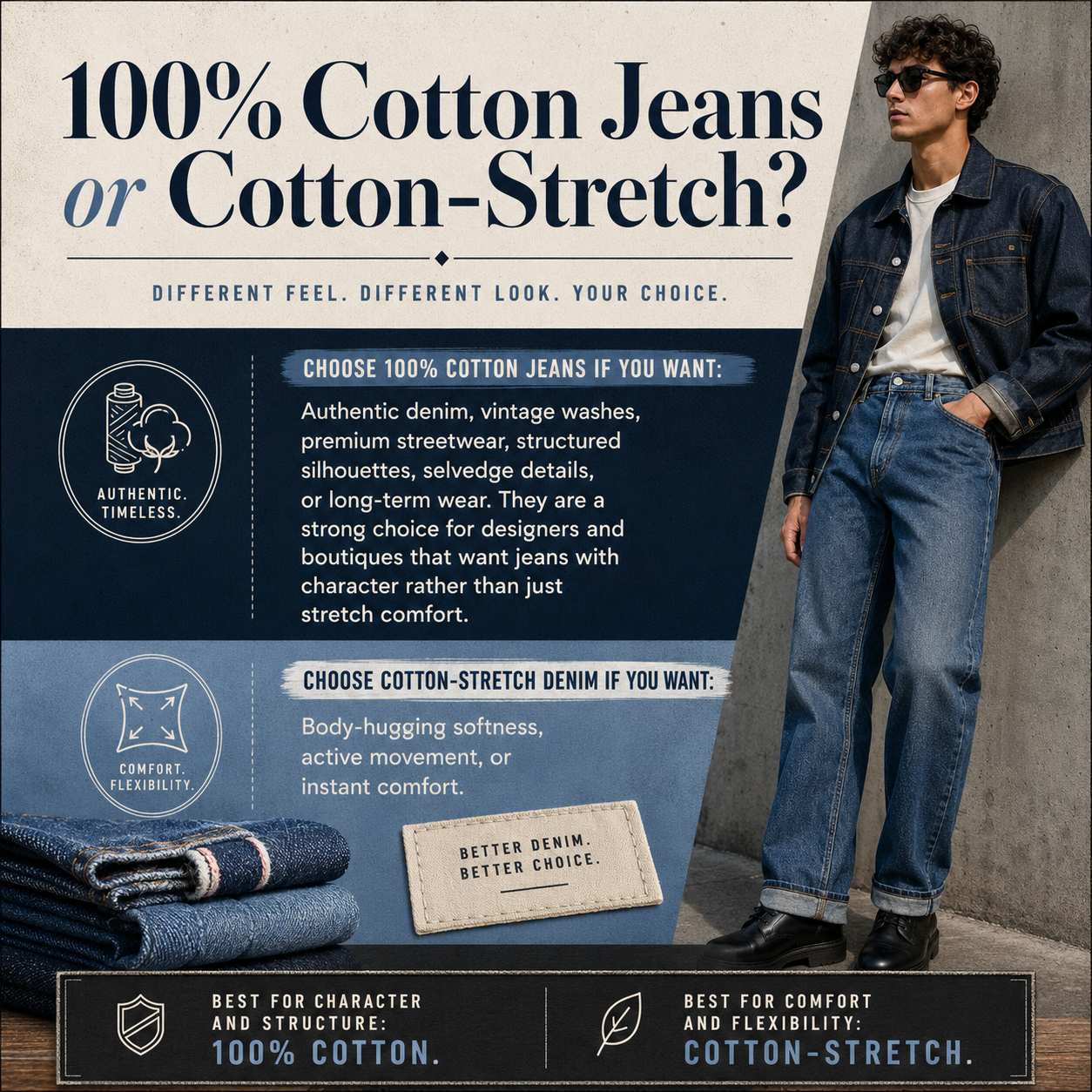
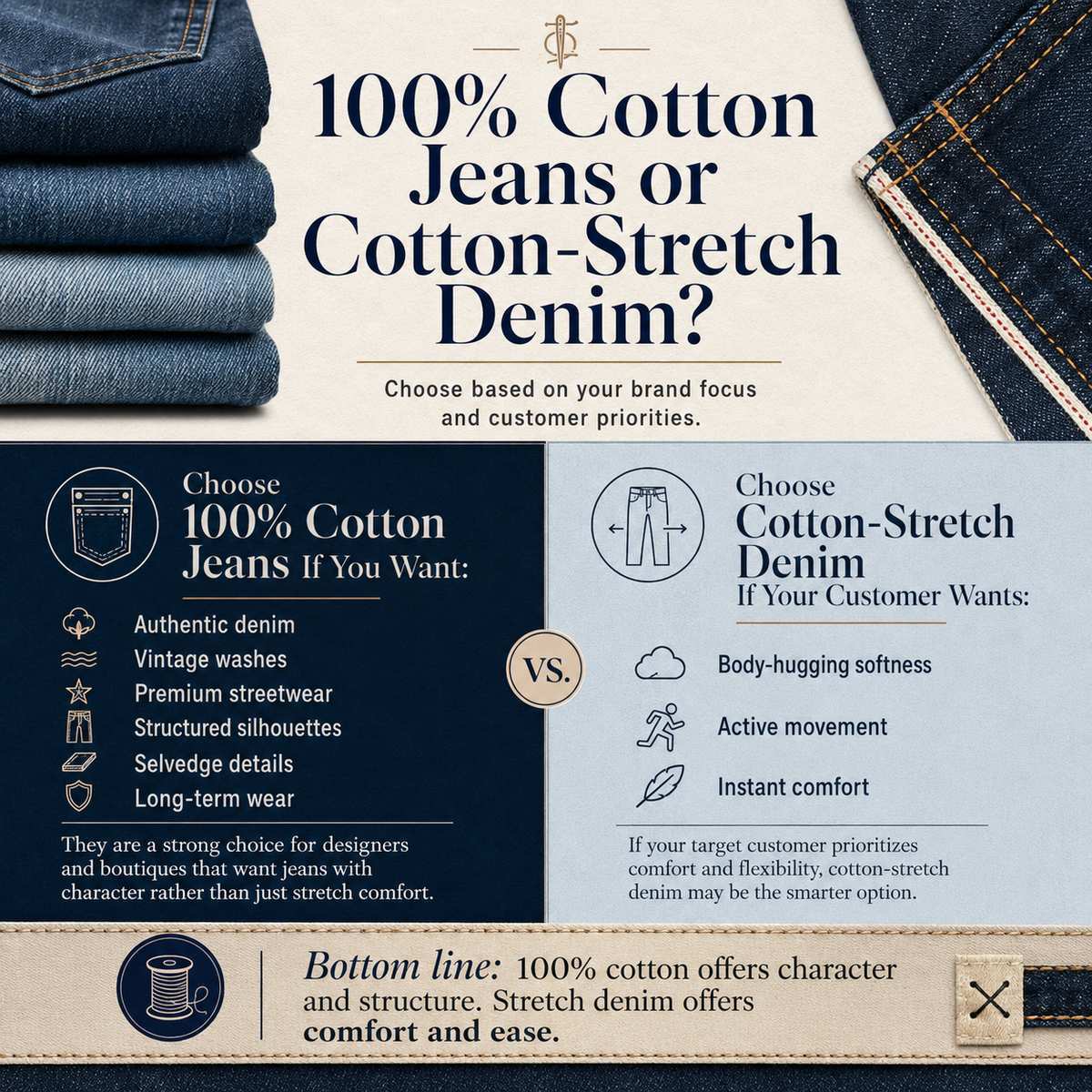
You should get 100% cotton jeans if your collection focuses on authentic denim, vintage washes, premium streetwear, structured silhouettes, selvedge details, or long-term wear. They are a strong choice for designers and boutiques that want jeans with character rather than just stretch comfort. However, if your target customer prioritizes body-hugging softness, active movement, or instant comfort, cotton-stretch denim may be a smarter option.
For a brand owner, “Should you get 100% cotton jeans?” is really a commercial question. You are not buying fabric for a museum. You are developing a product that must attract attention, fit real bodies, survive washing, photograph well, support your brand image, and make customers feel good enough to buy again. That means the decision must connect design, production, marketing, and customer behavior.
Start with your customer. If your customers are denim enthusiasts, vintage lovers, high-end streetwear shoppers, or people who appreciate craftsmanship, 100% cotton jeans can help you stand out. These customers often like structure. They may already understand that rigid jeans need time to break in. They may care about fabric weight, wash details, whiskers, grinding, pocket shape, rivets, leather patches, selvedge ID, chain stitching, and natural fades. For them, 100% cotton is not a disadvantage. It is part of the reason they buy.
If your customers are more comfort-driven, the answer may be different. Many online boutique shoppers want jeans that flatter the body immediately. They may want a smooth waist fit, stretch at the hips, and easier movement when sitting. If your return rate is mostly caused by “too tight,” “too stiff,” or “not comfortable,” then 100% cotton may need to be used carefully. You could still offer it, but maybe in relaxed fits, wide-leg jeans, boyfriend jeans, baggy jeans, or straight-leg designs instead of tight skinny fits.
Next, look at your price point. 100% cotton denim can support a premium price when the product is designed well. But fabric alone does not make jeans premium. A cheap pattern, weak washing, poor stitching, low-quality trims, or bad fit can ruin even a good fabric. If you want to sell 100% cotton jeans at a higher price, the full garment must support that story. The wash should look intentional. The waistband should sit correctly. The pockets should flatter the body. The seams should be clean. Hardware, labels, patches, embroidery, and packaging should match the brand level.
You should also think about photography and e-commerce. 100% cotton jeans often photograph beautifully because the fabric holds shape. Baggy jeans look more sculptural. Straight jeans look cleaner. Stacked jeans can create stronger folds. Denim jackets have better body. For Instagram boutiques, influencer shops, and online fashion brands, this visual structure matters. A soft stretch jean may feel great on the body but collapse on a hanger or look less defined in product photos. A structured cotton jean can create a stronger silhouette.
Here is a simple decision table:
| Your Brand Goal | Recommended Fabric Direction |
| Vintage-inspired premium jeans | 100% cotton denim |
| High-end selvedge collection | 100% cotton denim |
| Baggy streetwear jeans | 100% cotton or mostly cotton heavy denim |
Skinny fashion jeans | Cotton with elastane |
Plus-size comfort jeans | Test both rigid relaxed fits and stretch fabrics |
Online boutique bestsellers | Choose based on customer comfort expectations |
Denim jackets and shorts | 100% cotton is often a strong choice |
Fast-moving trend styles | Consider MOQ, wash cost, and sampling speed |
For many brands, the best strategy is not choosing only one fabric. A smart collection may include both 100% cotton and stretch denim. For example, your brand could launch a 100% cotton baggy jean, a straight-leg vintage wash jean, a stretch skinny jean, and a denim jacket. This gives customers options while keeping your brand identity strong.
The most important thing is to avoid copying another brand blindly. Just because a famous label sells rigid jeans does not mean your audience will accept them. Just because stretch jeans sell well on marketplaces does not mean your premium customer wants them. Product decisions should come from your customer, your brand positioning, your design language, and your production capability.
If you are a small brand or boutique, start with a focused test. You do not need to order 10,000 pieces immediately. A low-MOQ custom denim order can help you test fabric, fit, wash, and customer feedback before scaling. Once you know which style sells, you can improve the next batch and increase production volume. This is especially useful for designers, influencer stores, and online boutiques that need flexibility.
How Can Custom Denim Brands Develop Better 100% Cotton Jeans?
Custom denim brands can develop better 100% cotton jeans by choosing the right fabric weight, controlling shrinkage, adjusting patterns for rigid denim, testing washes, and working with an experienced OEM/ODM denim factory. Good development should cover fit, construction, trims, branding, packaging, and customer care instructions. The goal is not only to make jeans, but to create a product that fits your market and supports your brand story.
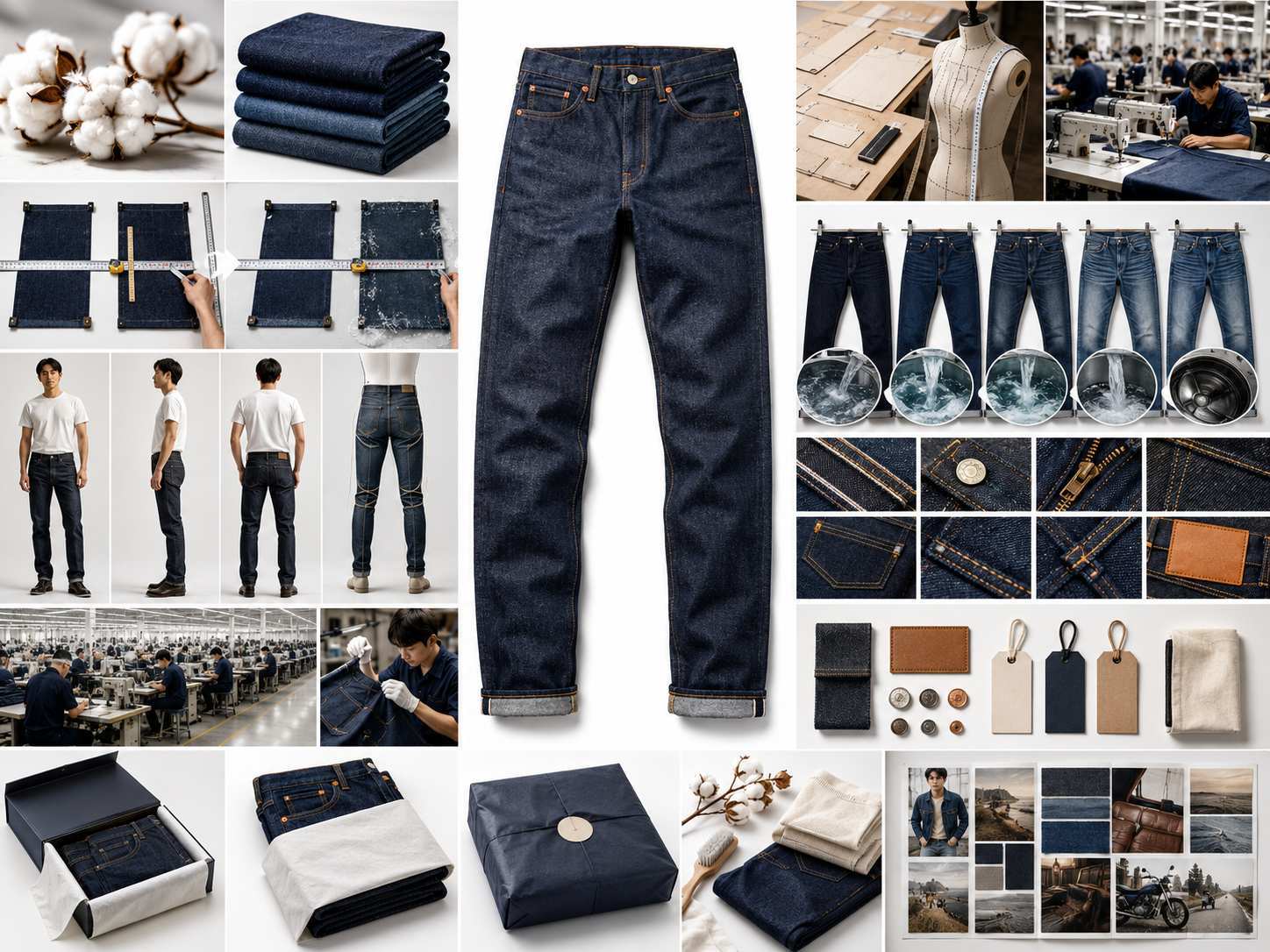
Developing 100% cotton jeans is not just about buying denim fabric and sewing a pair of pants. Every decision affects the final customer experience. A 10 oz cotton denim and a 14 oz cotton denim may both be 100% cotton, but they will feel completely different. A light wash, enzyme wash, stone wash, acid wash, or raw finish will also change softness, shrinkage, color, and visual identity. This is why experienced denim development matters.
The first step is fabric selection. Brands should consider fabric weight, yarn character, weave, color, stretch requirement, shrinkage rate, and wash performance. Lightweight denim may work well for shirts, summer jeans, and shorts. Medium-weight denim can be good for everyday jeans. Heavyweight denim works better for structured, premium, or workwear-inspired products. If your design needs sharp stacking at the ankle, the fabric must have enough body. If your design needs a relaxed drape, the fabric should not be too stiff.
The second step is fit development. 100% cotton jeans need more careful pattern making than stretch jeans. Since the fabric does not stretch much, the pattern must include proper ease. The rise, hip, thigh, knee, leg opening, waistband curve, and inseam all need to work together. For baggy jeans, the goal is not simply making everything bigger. The jeans still need balance. For straight jeans, the leg line must look clean. For stacked jeans, the inseam and leg opening must create the right folds. For plus-size jeans, the pattern must support comfort, proportion, and confidence.
The third step is wash development. Wash can turn a basic pair of jeans into a bestseller—or destroy the product if done poorly. A vintage wash needs the right contrast. A black wash needs color control. A distressed jean needs handwork placement that looks natural. A stacked jean may need fading that highlights the folds. A denim jacket may need consistent panel matching. Wash development is one of the biggest reasons to work with a factory that understands complex denim customization.
The fourth step is branding. If you are building your own denim brand, your logo should not be an afterthought. Customization can include leather patches, jacron patches, woven labels, metal buttons, rivets, embroidery, screen printing, pocket stitching, hang tags, packaging bags, and barcode labels. For online boutique owners, these details help make the product feel exclusive. For high-end brands, they reinforce identity and perceived value.
The fifth step is testing. Before bulk production, brands should confirm size specs, shrinkage, colorfastness, wash effect, seam strength, button and rivet quality, packaging, and final measurement tolerance. This matters even more for 100% cotton denim because small changes in washing or shrinkage can affect the final fit. A professional sample process can save money by preventing bulk mistakes.
Here is a practical development checklist:
| Development Step | What to Confirm | Why It Matters |
| Fabric Selection | Weight, composition, color, shrinkage | Determines feel, fit, and product positioning |
| Pattern Making | Rise, hip, thigh, inseam, leg opening | Controls comfort and silhouette |
| Wash Development | Color, fading, softness, distressing | Creates visual value and brand style |
Trims & Branding | Buttons, rivets, patches, labels | Makes the product recognizable |
Sample Fitting | Fit on body, movement, sizing | Reduces return risk |
Bulk Production | Measurements, wash consistency, QC | Protects brand reputation |
For small and mid-sized buyers, flexibility is extremely important. Many new brands cannot start with huge quantities. They need a factory that can support small test orders, help improve samples, and scale up when the design becomes a bestseller. DiZNEW supports low MOQ custom denim orders starting from 30 pieces, while also being able to handle large-volume orders up to 10,000 pieces. This makes it easier for new designers, online boutiques, and influencer brands to test a product before committing to a major inventory investment.
For established brands, the challenge is often different. They may already have sketches, tech packs, reference samples, or a clear design direction, but they need a manufacturing partner that can execute difficult details. Complex denim customization may include special washes, stacked effects, wide-leg proportions, selvedge construction, embroidery, patchwork, distressing, cargo pockets, custom hardware, or brand-specific fit blocks. In these cases, factory experience becomes a competitive advantage.
A strong custom denim factory does more than sew. It helps translate ideas into wearable products.
Quick Buyer Guide: When 100% Cotton Denim Makes the Most Sense
100% cotton denim is not the answer for every product, but it is often the right answer when the jeans need structure, authenticity, and a long-term brand story.
| Buyer Type | Why 100% Cotton May Work |
| Denim Designers | Supports original silhouettes, premium washes, and creative construction. |
| Online Boutique Owners | Creates strong product photos and a more exclusive product feel. |
| High-End Streetwear Brands | Works well for baggy, stacked, carpenter, and oversized denim trends. |
Heritage Denim Labels | Matches selvedge, raw denim, and vintage-inspired storytelling. |
Influencer Shops | Helps create recognizable signature jeans instead of generic basics. |
Private-Label Brands | Offers a strong foundation for OEM/ODM logo customization. |
If your customer is buying jeans mainly for stretch comfort, then a cotton-elastane blend may be better. If your customer is buying jeans for style, texture, shape, and identity, 100% cotton deserves serious consideration.
Final Thoughts: 100% Cotton Jeans Are Not Just a Fabric Choice—They Are a Brand Decision
So, should you get 100% cotton jeans? If your goal is to create denim with structure, character, vintage appeal, and long-term value, the answer is yes. 100% cotton denim gives brands a strong foundation for premium collections, especially when used in the right styles: baggy jeans, straight jeans, stacked jeans, selvedge jeans, denim jackets, denim shorts, and denim shirts. It gives the product a real denim attitude that many customers still love.
But the smartest brands do not choose 100% cotton blindly. They match the fabric to the fit, the customer, the price point, and the brand story. They understand that 100% cotton can feel stiff at first. They plan for shrinkage. They test the wash. They adjust the pattern. They explain the break-in process honestly. This is how a possible disadvantage becomes a selling point.
For designers, boutique owners, online fashion stores, influencer brands, and private-label buyers, the opportunity is clear: customers are tired of generic jeans. They want products that feel intentional. They want jeans with shape, personality, and a reason to exist. A well-developed pair of 100% cotton jeans can do exactly that.
DiZNEW is a China-based denim jeans manufacturer with more than 20 years of experience in denim development, manufacturing, customization, OEM, and ODM production. We help brands turn sketches, reference samples, tech packs, and creative ideas into real denim products. Whether you need plus-size jeans, baggy jeans, stacked jeans, straight jeans, selvedge jeans, skinny jeans, jogger jeans, denim jackets, denim shorts, or denim shirts, our team can support both small-batch development and large-volume production.
If you are planning a 100% cotton denim collection, or if you are not sure whether pure cotton, stretch denim, or a blended fabric is better for your brand, DiZNEW can help you compare options and develop the right product.
Contact DiZNEW today to start your custom denim project. Send us your design idea, reference photos, size requirements, logo details, target price, and order quantity. We can help you create denim jeans that look good, fit well, and carry your brand identity from concept to finished product.
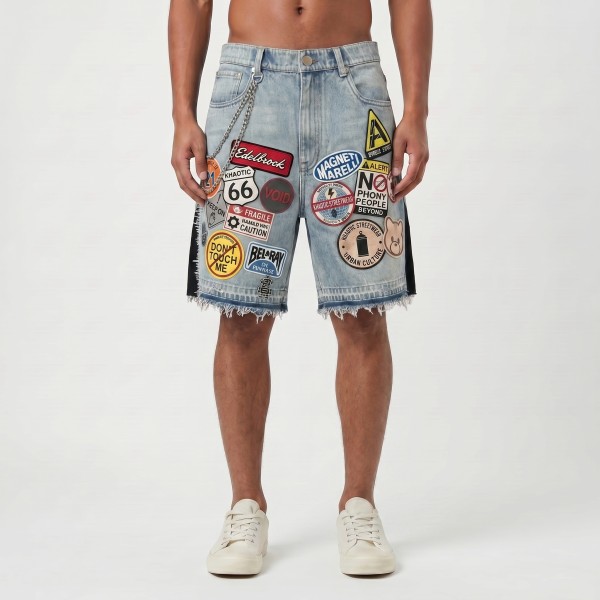
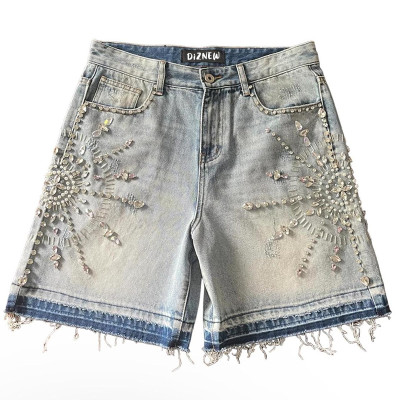
Streetwear-inspired custom denim shorts with utility pockets, distressed wash, and fringe hem for bold collections.
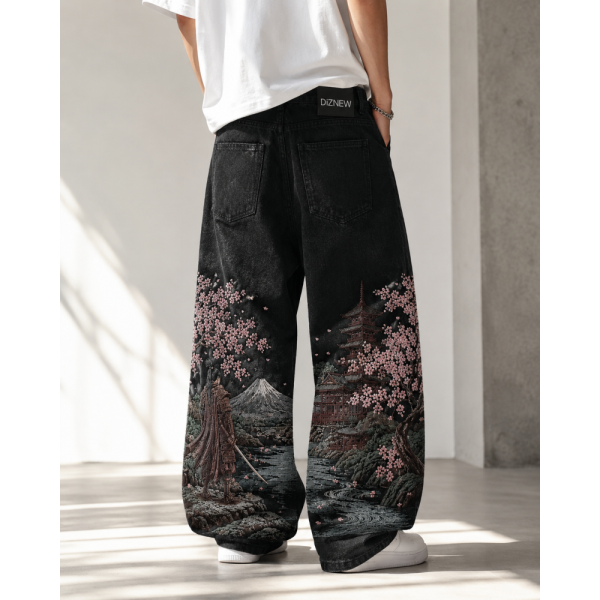
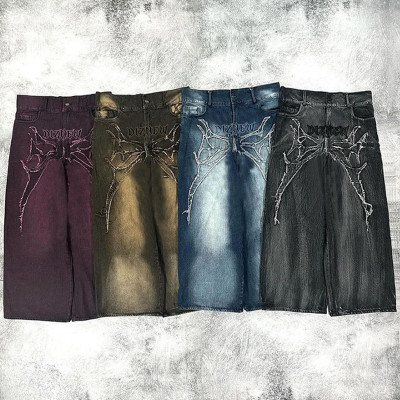
Premium wide-leg denim jeans featuring a vintage washed black finish, detailed Japanese landscape artwork, embroidery-style decoration, and custom brand label options. Designed for streetwear brands, designer labels, and private label collections looking for statement denim with strong visual storytelling.
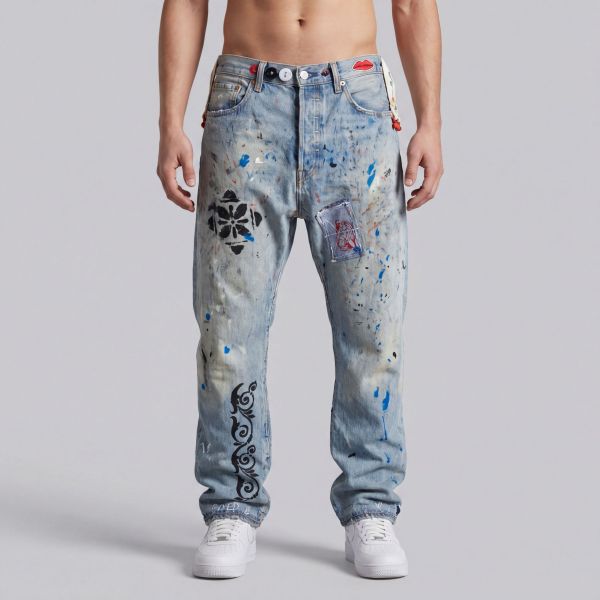
Discover our Custom Gray-Blue and Mud Yellow Color Block Denim Jacket, offering OEM & ODM services for your unique designs.
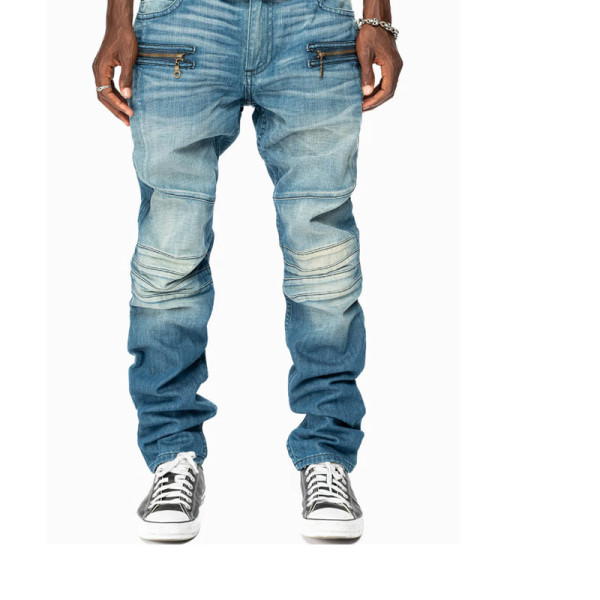
Custom Blue Cycling Jeans: Tailored for performance with OEM & ODM services. Perfect for brands seeking unique denim solutions.