What is the difference between straight leg and skinny jeans?
For years, buying jeans seemed simple. If you wanted a sharp, fitted look, you chose skinny jeans. If you wanted something more classic, you picked straight legs. That distinction still exists, but modern denim has made the choice much more interesting. Fabric stretch, rise, thigh width, knee shape, hem opening, body proportions, footwear, and even the way people style oversized clothing can completely change how the same jeans look and feel.
For shoppers, that means the label on the hangtag only tells part of the story. For fashion brands and denim designers, the difference becomes even more important because a few centimeters in the knee or leg opening can change the entire character of a product.
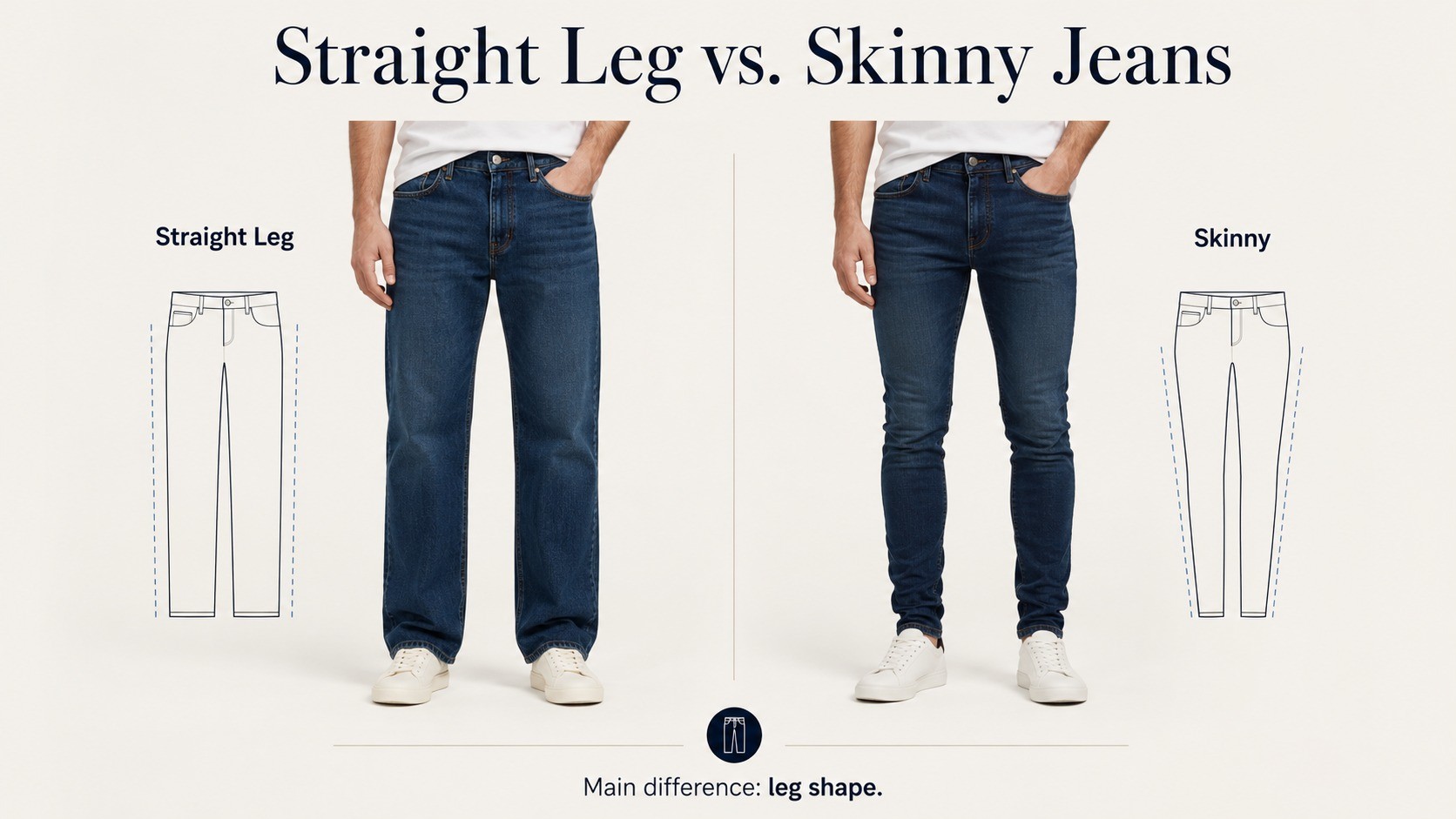
Straight leg jeans maintain a relatively consistent leg width from the thigh or knee toward the hem, creating a clean and balanced silhouette. Skinny jeans sit much closer to the body and taper tightly through the thigh, knee, calf, and ankle. Straight jeans usually provide more physical room and styling flexibility, while skinny jeans create a sharper, body-hugging shape that often relies on stretch denim for comfort.
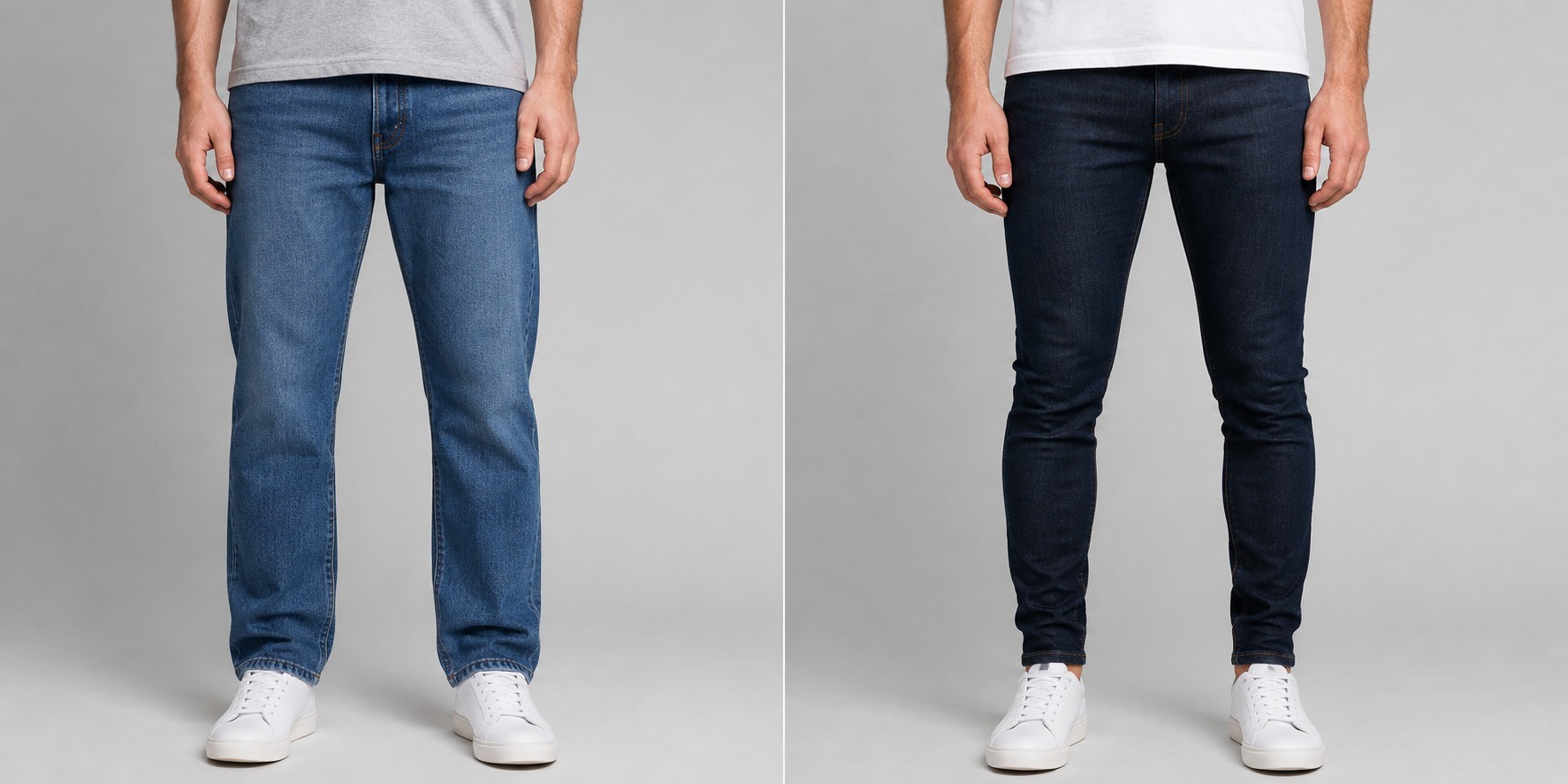
Current 2026 denim trends make this comparison especially relevant. Straight-leg jeans remain one of the strongest core silhouettes, while skinny jeans are returning in softer forms such as slim, cigarette, and narrow straight fits rather than only the extremely tight styles associated with the 2010s.
That is why asking which pair is better can lead to the wrong answer. The useful question is what happens when the jeans actually go on a body, move through a normal day, and meet the rest of an outfit. The difference starts with the pattern.
What Is the Main Difference Between Straight Leg and Skinny Jeans?
The main difference is the leg shape. Straight leg jeans keep a cleaner, more consistent width down the leg, while skinny jeans progressively hug and narrow around the thigh, knee, calf, and ankle. This structural difference affects comfort, movement, fabric choice, visual proportions, footwear compatibility, and how the jeans behave after repeated wear.
How Do Straight Leg Jeans Fit?
Straight leg jeans are designed to create a relatively continuous vertical line. Depending on the pattern, they may sit close through the seat and upper thigh before falling straighter from the knee, or they may maintain more ease from the hip downward.
That distinction matters because the term "straight leg" covers more than one exact measurement.
A slim straight jean may fit quite close through the thigh and open only slightly below the knee. A classic straight cut has more room through the leg. A relaxed straight jean can have considerably more thigh and seat ease while still maintaining a straight lower-leg shape.
What connects them is the absence of aggressive tapering toward the ankle.
This structure makes straight jeans visually stable. The eye follows a cleaner line from the upper leg toward the hem. That is one reason straight silhouettes are regularly described as versatile and widely flattering. Current fashion coverage in 2026 still treats straight-leg denim as an important wardrobe foundation rather than a short-term trend.
How Do Skinny Jeans Fit?
Skinny jeans follow the body much more closely.
The pattern is reduced through the thigh, knee, calf, and hem so the fabric stays near the leg instead of falling away from it. This gives skinny jeans their familiar narrow silhouette.
The difference becomes especially visible below the knee. Straight jeans generally continue downward with relatively little change in width. Skinny jeans continue narrowing toward the ankle.
Because the garment must fit close while still allowing walking, sitting, bending, and climbing stairs, fabric performance becomes extremely important. Many commercial skinny jeans include elastane or another stretch fiber. H&M's current fit guide, for example, describes skinny jeans as commonly using stretch denim with roughly 1 to 2 percent elastane, while its straight-leg examples lean more heavily toward structured cotton denim.
That percentage may look small on a specification sheet, but in denim development it can dramatically change stretch, recovery, comfort, and the way the garment holds its shape.
What Is the Difference in the Thigh, Knee, Calf, and Leg Opening?
The easiest way to understand the two fits is to examine where the pattern changes.
| Fit Area | Straight Leg Jeans | Skinny Jeans |
| Seat | Fitted or moderately relaxed | Usually close fitting |
Thigh | Skims or lightly follows the leg | Closely follows the leg |
Knee | Maintains more width | Noticeably narrower |
| Calf | Usually has visible ease | Hugs the calf |
Leg opening | Moderate and relatively straight | Narrow and fitted around ankle |
| Movement | More natural physical space | Depends heavily on fabric stretch |
Typical silhouette | Clean vertical line | Body-contoured tapered line |
There is no universal industry measurement that defines every straight or skinny jean because measurements change with gender, size, brand positioning, rise, fabric, and intended aesthetic.
For a denim manufacturer, this is why copying only the hem measurement rarely creates a successful fit.
The thigh, knee, rise, seat curve, back rise, hip, inseam, and leg opening all need to work together.
A skinny jean with an excessively narrow hem but too much knee width can look awkward. A straight jean with too little thigh ease can behave like a skinny fit on someone with larger legs.
Do Straight Leg and Skinny Jeans Use Different Denim Fabrics?
They can use the same basic denim category, but they often need different fabric properties.
Straight jeans can work beautifully in rigid 100 percent cotton denim because the pattern itself provides room for movement. Heavy or medium-weight rigid denim also helps maintain a defined shape.
Skinny jeans usually benefit from stretch.
A common construction may combine cotton with a small percentage of elastane. Some fabrics also use polyester or other fibers to improve recovery, softness, durability, or stability.
The important word is recovery.
Stretch tells you how far the fabric can expand. Recovery tells you how effectively it returns after expansion.
Poor recovery is one reason cheap skinny jeans sometimes look good in the morning and loose around the knees by the afternoon.
Brands developing fitted denim should therefore test more than the fabric composition label. Stretch percentage, recovery, dimensional stability after washing, hand feel, and repeated wear performance matter just as much.
What Are the Key Differences Between Straight Leg and Skinny Jeans?
If you compare two properly developed jeans in the same size, the straight fit generally gives the leg more space and creates a cleaner column shape. The skinny fit creates more contact with the body and a visibly narrower ankle.
Neither construction is technically superior.
They solve different design problems.
For a fashion brand, choosing between them should start with the intended customer and styling direction rather than copying whichever silhouette is currently getting the most attention on social media.
A premium minimalist brand may want a rigid straight jean with a precise drape. A nightlife-focused label may still need a dark, stretchy skinny jean. A streetwear company may prefer a slim straight fit that sits between those two extremes.
That middle ground is becoming increasingly important in 2026.
Are Straight Leg Jeans More Flattering Than Skinny Jeans?
Straight leg jeans often create a balanced silhouette because their cleaner vertical line does not closely trace every change in the leg. Skinny jeans emphasize the body's natural outline more strongly. Neither fit is automatically more flattering. Rise, thigh room, inseam, wash, footwear, and the proportions of the wearer often matter more than the fit name itself.

Do Straight Leg Jeans Make You Look Slimmer?
They can, although the effect depends on the complete pattern.
A well-cut straight jean creates continuity from the hip toward the floor. This can visually reduce sharp changes between the thigh, knee, and calf.
Dark washes strengthen that effect because they produce less visual interruption. A full-length hem with similar-tone footwear can extend the vertical line even further.
The opposite can also happen.
A straight jean that is too wide, too short, or poorly positioned at the rise may shorten the leg visually or create unnecessary bulk.
This is why "straight jeans make everyone look slim" is too simplistic.
Fit is a proportion problem.
The correct waist position, hip balance, thigh ease, knee placement, hem width, and inseam need to work with the person wearing the jeans.
Do Straight Leg Jeans Make Your Legs Look Longer?
They often can.
High-rise straight jeans can visually move the apparent starting point of the leg upward, while a longer uninterrupted leg line can make the lower body look more extended.
Footwear matters here.
A cropped straight jean that finishes well above the ankle creates a different visual effect from a full-length pair touching the shoe.
For brands, inseam development deserves more attention than it often receives. Simply grading one standard inseam across a broad size range can create inconsistent proportions, particularly when a brand serves petite, tall, or plus-size customers.
Do Skinny Jeans Make You Look Thinner?
Skinny jeans create definition rather than automatic thinness.
They expose the actual contour of the leg more clearly because there is very little fabric separation between the body and garment.
On some wearers, that creates a sleek and elongated appearance. High-rise skinny jeans paired with boots or similar-tone shoes can produce a continuous visual line.
On other wearers, a very narrow ankle may make the upper thigh or hip appear relatively fuller because the difference between upper and lower leg width becomes more obvious.
That is a proportion effect, not a problem with the person's body.
It also explains why modern slim and cigarette fits are gaining interest. They retain a narrower appearance without always creating the extreme taper of classic spray-on skinny denim. Vogue's 2026 coverage points to this broader return of slimmer silhouettes while straight fits remain strong.
Are Straight Leg Jeans More Flattering Than Skinny Jeans?
For the widest group of customers, straight jeans are usually easier to fit and style.
They leave more physical space in the lower leg and work with more footwear categories. Sneakers, loafers, sandals, heels, work boots, and many ankle boots can all work with the same basic silhouette.
Skinny jeans are more specific.
Their fitted lower leg makes them especially useful when the wearer wants to tuck jeans into tall boots, show a statement shoe, or balance an oversized top with a narrow lower half.
Fashion experts quoted in recent fit guides also tend to describe straight legs as particularly versatile, while stressing that flattering denim depends on lifestyle, proportions, rise, fabric, and styling rather than one universal cut.
Which Jeans Create Better Body Proportions?
The pair that creates the right relationship between the upper and lower body.
Imagine an oversized leather jacket.
A skinny jean beneath it creates a dramatic wide-to-narrow contrast. That was a defining proportion for much of the 2010s.
Put the same jacket over straight jeans and the outfit looks less sharply contrasted and more relaxed.
Put it over baggy jeans and the entire silhouette becomes oversized.
None of those choices is technically wrong. They communicate different aesthetics.
This is also why denim brands should develop jeans as part of a collection rather than treating every bottom as an isolated product. Tops, jackets, footwear, customer age, market, and styling direction all influence which leg shape feels right.
What Body Type Looks Best in Straight Leg or Skinny Jeans?
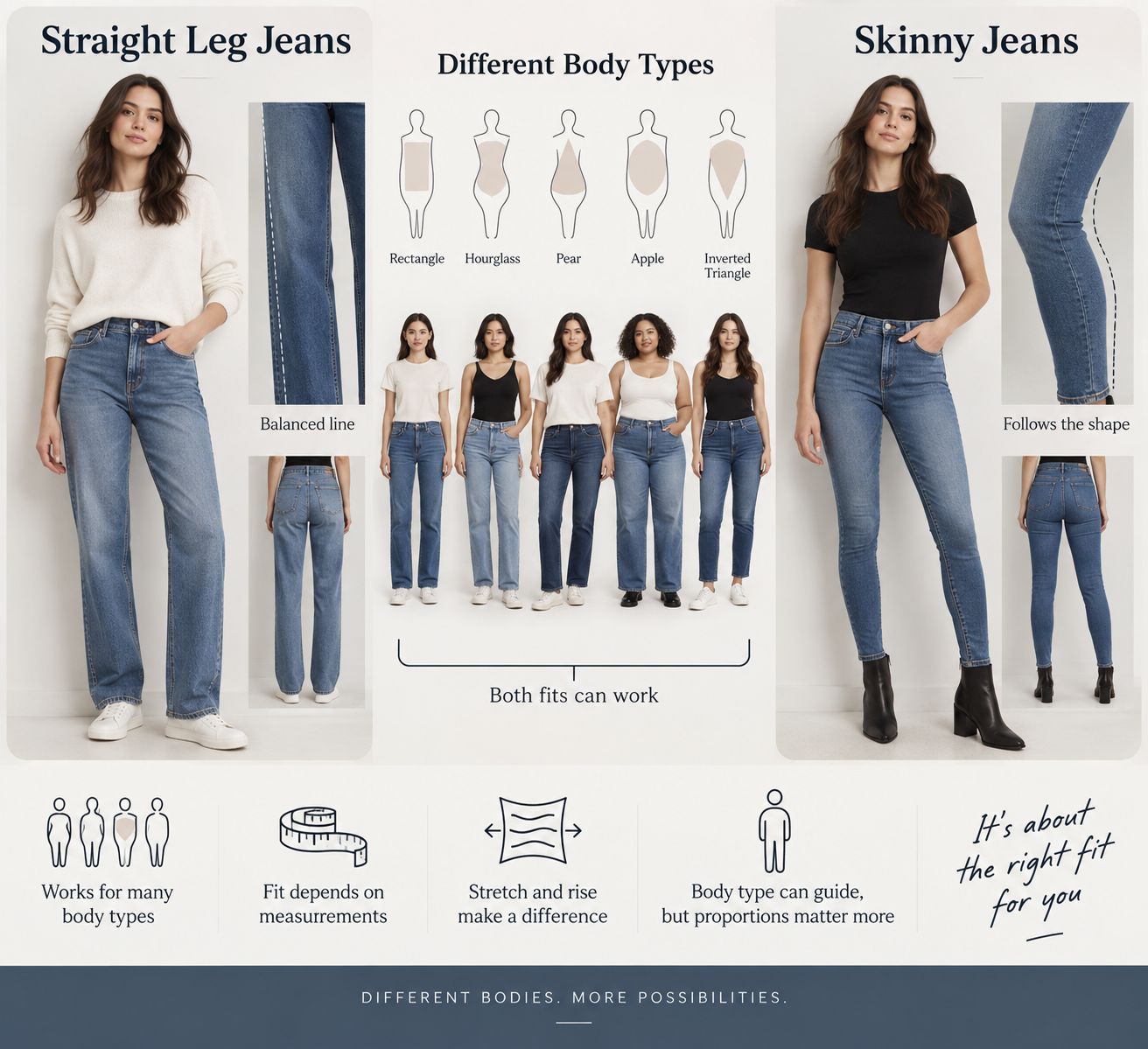
Straight leg jeans work across many body types because the leg falls in a relatively balanced line instead of closely following the calf and ankle. Skinny jeans can also suit many figures, especially when rise, stretch, and thigh measurements are correctly developed. Body type can guide selection, but individual proportions and garment measurements provide a much more reliable answer.
What Body Type Looks Good in Straight Leg Jeans?
Straight jeans are particularly adaptable for people who want more balance through the lower half of the body.
Someone with fuller hips or thighs may like how a straight lower leg creates continuity rather than narrowing dramatically at the calf.
Someone with an athletic build may appreciate the extra thigh and calf room.
Someone with a straighter figure may use the clean leg line to create a structured silhouette.
Petite customers can also wear straight jeans successfully when the rise, inseam, and leg opening are proportioned correctly.
The phrase "best body type" can therefore be misleading.
Two people can have the same waist measurement and completely different hip, thigh, rise, and calf proportions.
That difference is exactly why professional denim pattern development matters.
What Body Type Looks Best in Skinny Jeans?
Skinny jeans work especially well for people who actively want to show the contour of their legs.
They can look sharp on slender frames, but they are by no means restricted to them.
Curvier wearers can also look excellent in skinny denim when the waist-to-hip ratio, back rise, thigh width, and fabric stretch have been developed properly.
This is where many low-cost fits fail.
Manufacturers sometimes create larger sizes by mechanically grading every point outward from a smaller base size. Real bodies do not scale in perfectly equal percentages.
Plus-size denim often needs specific adjustments to rise, seat shape, hip curve, thigh room, knee placement, and waistband construction.
A strong plus-size skinny jean therefore requires more than making the original pattern bigger.
Are Straight Leg Jeans Good for Curvy Bodies?
Very often, yes.
The straight lower leg can balance fuller hips and thighs by keeping more visual width below the knee.
A higher rise may also help create waist definition if that is the desired look.
Fabric selection changes the experience.
Rigid denim provides structure and can hold a strong shape, but it must have enough pattern ease through the seat and thigh. Stretch denim gives more adaptability but needs good recovery to avoid sagging.
Curvy customers often feel a common frustration. The jeans fit the hips but leave a gap at the back waist.
That problem is usually a pattern issue.
A contoured waistband, adjusted back rise, better yoke angle, or more appropriate waist-to-hip relationship can solve it far more effectively than simply reducing the size.
Which Jeans Are Better for Bigger Thighs?
Straight jeans are generally easier to fit when the wearer has larger thighs because they can provide more room without requiring the fabric to stretch constantly.
Athletic customers often experience a familiar problem with skinny jeans. The waist fits, but the thigh is too tight. Moving up one size solves the thigh problem and creates another problem at the waistband.
That tells you the shape is wrong, not necessarily the size.
A custom straight or athletic straight fit can maintain a clean silhouette while adding strategic room through the thigh.
For brands targeting this customer, one extra fitting session can be more valuable than adding another wash color to the collection.
Are Straight Leg or Skinny Jeans Better for Petite People?
Both can work.
Petite customers usually benefit most from controlling inseam and proportion.
A skinny jean can create a continuous narrow line, especially with high-rise styling. A straight jean can also elongate the body when the hem does not overwhelm the shoe.
The common mistake is treating "petite" as simply shorter.
Petite denim may need changes in rise depth, knee position, pocket placement, yoke proportion, and leg opening in addition to inseam.
This illustrates a larger point for brands.
Good fit comes from three-dimensional proportion. Waist size alone cannot describe a body.
Which Is More Comfortable, Straight Leg or Skinny Jeans?
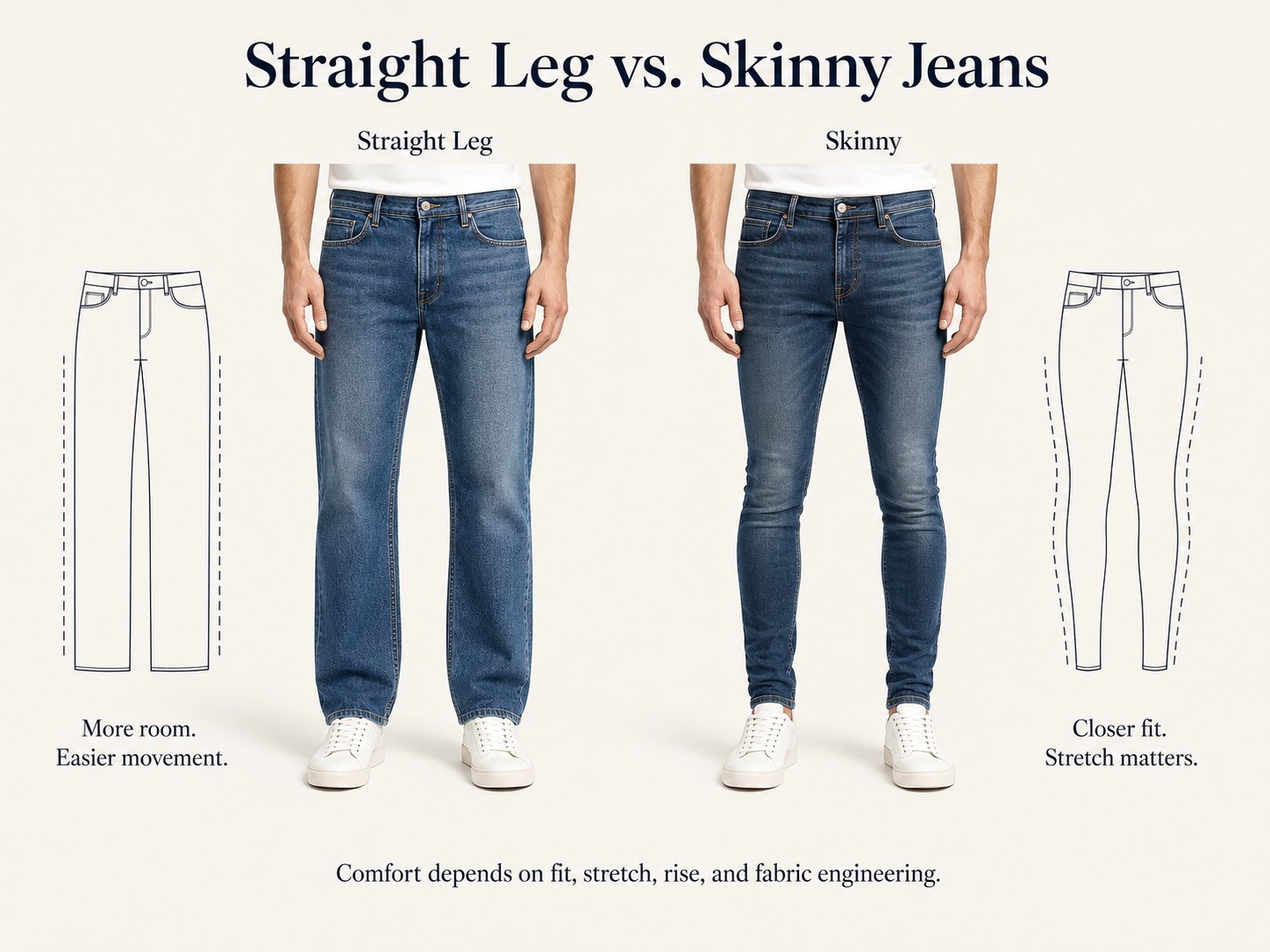
Straight leg jeans usually provide more natural physical room through the thigh, knee, calf, and ankle, so many people find them easier for long periods of sitting and movement. Skinny jeans can still be highly comfortable when stretch, recovery, rise, and pattern balance are correct. Fabric engineering often matters as much as the silhouette itself.
Are Straight Leg Jeans More Comfortable Than Skinny Jeans?
In many everyday situations, yes.
The lower leg is less compressed. The knee has more room to bend. The calf is less restricted. Air can move more easily around the leg.
Those differences become noticeable during a long day.
Think about sitting at a desk, driving, walking through an airport, climbing stairs, eating dinner, and then wearing the same jeans for several more hours.
A pair that feels perfect for thirty seconds in front of a mirror may feel very different after eight hours.
Recent comparisons of straight and skinny jeans also tend to give straight styles an advantage in physical ease, while noting that good stretch denim can make skinny fits comfortable.
Why Do Skinny Jeans Feel Tighter?
The answer sounds obvious, but several forces are happening at once.
The garment has less pattern ease.
More areas of the fabric remain in contact with the body.
The fabric is repeatedly stretched when the knee bends or the wearer sits.
Pressure can also accumulate around the waistband, thigh, back knee, and calf if the pattern is too aggressive.
A good skinny fit manages these areas carefully.
More stretch does not automatically solve a poor pattern.
If the front rise is too short, the waistband may pull downward when sitting. If the thigh is too narrow, extra elastane may make the jeans wearable but still uncomfortable. If recovery is weak, increasing stretch can create bagging.
Pattern and fabric have to be developed together.
Do Skinny Jeans Need Stretch Denim?
Most modern commercial skinny jeans benefit from it.
H&M's current denim guide identifies elastane as a common component of skinny denim, with approximately 1 to 2 percent used in some constructions.
The percentage alone does not tell the entire story because stretch performance varies according to yarn, weave, finishing, fabric weight, and fiber technology.
Two fabrics that both list 2 percent elastane can behave very differently.
One may feel soft and recover quickly.
Another may stretch easily and remain loose around the knees.
That is why professional sampling normally involves actual garment wash testing and fit evaluation rather than approving a fabric only from its composition sheet.
Are 100% Cotton Straight Leg Jeans Comfortable?
They can be extremely comfortable when the pattern is right.
Rigid denim feels different from stretch denim.
It often feels firmer when new, particularly at heavier weights. With wear, cotton denim can soften and begin to reflect the movement patterns of the wearer.
Many denim enthusiasts actually prefer this relationship with the fabric.
The jeans develop creases, fading, abrasion, and shape over time.
The limitation is clear. Rigid denim cannot compensate for an incorrect pattern by stretching around the body.
If a brand develops 100 percent cotton jeans, accurate seat, thigh, rise, and waistband measurements become especially important.
Which Jeans Are Better for Everyday Wear?
For general versatility, straight jeans currently have a strong argument.
They work across more footwear choices, tolerate more leg shapes, and fit naturally with the relaxed proportions that continue to influence 2026 fashion. GQ's current fall 2026 menswear coverage, for example, highlights fuller thighs and straighter, more relaxed trouser shapes inspired by the 1990s.
Skinny jeans still have practical advantages.
They fit easily into boots, create a neat silhouette under longer coats, and work well for customers who dislike excess fabric around the lower leg.
The better everyday jean is therefore the one that matches the customer's real routine.
Comfort should be tested while sitting, walking, bending, and wearing the garment for hours, not only while standing in front of a fitting-room mirror.
Are Skinny Jeans Still in Style, or Are Straight Leg Jeans Better in 2026?
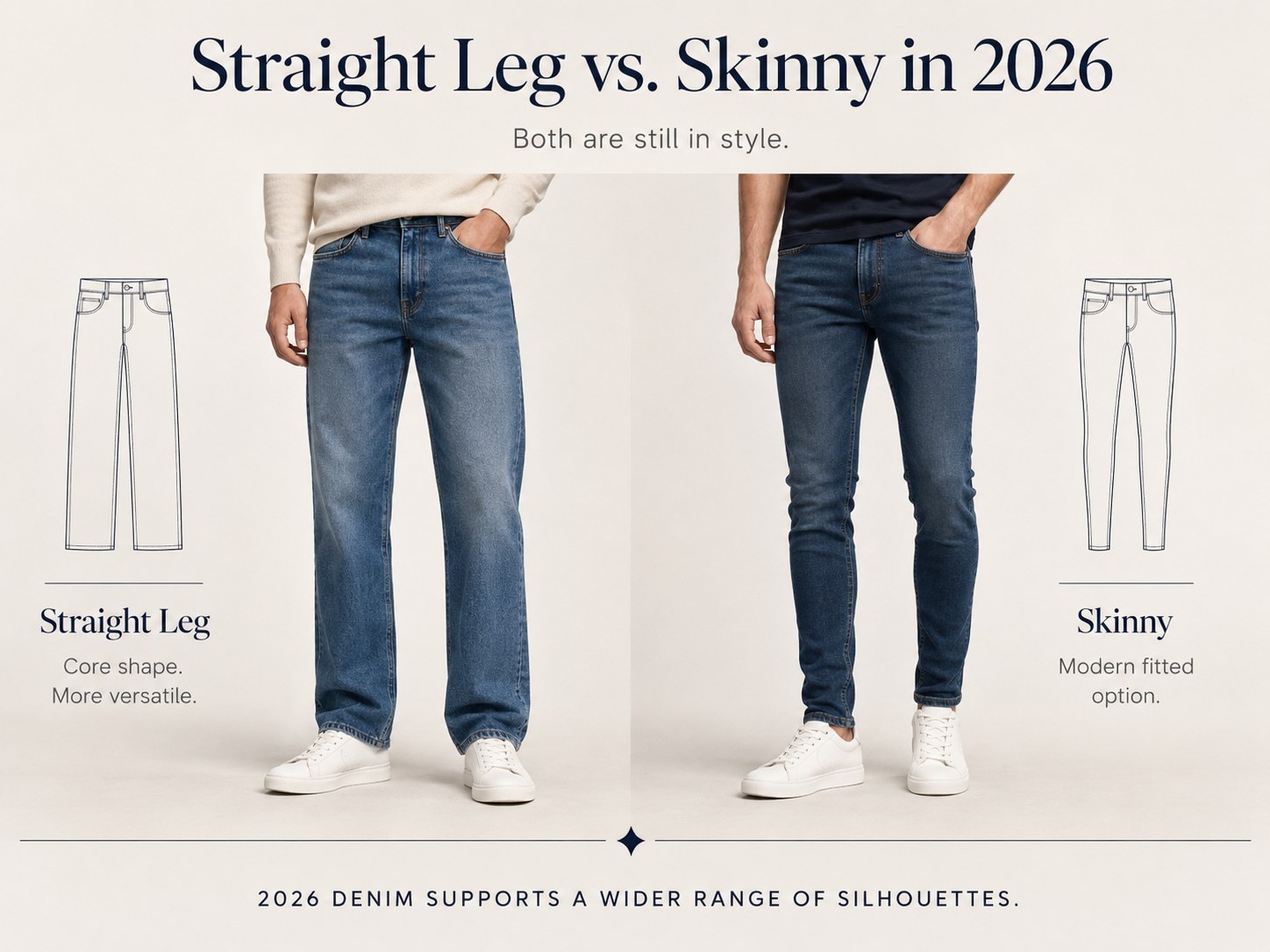
Skinny jeans are still in style in 2026, but the market now supports a wider range of silhouettes. Straight-leg jeans remain a major core shape, while slimmer fits are returning through modern skinny, slim, stovepipe, and cigarette interpretations. For most customers, straight jeans offer greater versatility, while skinny jeans remain useful for fitted outfits and specific styling preferences.
Are Skinny Jeans Out of Style in 2026?
No.
That answer is worth stating clearly because fashion headlines often treat trends like a switch that turns one silhouette off when another appears.
Current 2026 runway and fashion coverage shows both straight and slim denim in active circulation.
Vogue's 2026 denim trend guide identifies straight jeans as one of the season's major cuts while also documenting the return of skinny and slim silhouettes. British Vogue likewise continues to highlight straight-leg denim as a lasting shape, and more recent coverage shows designers reworking slimmer jeans in less restrictive forms.
That is a much more useful way to understand denim in 2026.
Consumers have more choices.
Baggy jeans can exist beside straight jeans. Straight jeans can exist beside bootcut. Slim and skinny jeans can return without forcing everyone into the same silhouette.
For brands, this means eliminating skinny denim completely because of a social-media trend can be as risky as building the whole collection around it.
Customer data matters more.
Look at actual sales by market, age, gender, fit, rise, wash, and return reason.
Why Does Gen Z Not Like Skinny Jeans?
The premise needs some qualification because Gen Z is not one group with one wardrobe.
Still, younger consumers played an important role in shifting mainstream styling away from the ultra-tight jeans associated with the late 2000s and 2010s.
Several factors helped.
Relaxed and oversized silhouettes became more visible.
1990s and Y2K references returned.
Baggy jeans, carpenter jeans, cargos, straight legs, wide legs, and low-rise styles offered younger shoppers ways to separate their look from the previous generation's dominant uniform.
Comfort also mattered.
Once people became accustomed to wider trousers and relaxed denim, tightly compressed calves and ankles could feel unnecessary.
The social meaning of skinny jeans changed too.
Clothing becomes generational when one group wears a particular silhouette for long enough. Skinny jeans became strongly associated with Millennial-era styling, just as other generations have their own recognizable shapes.
Yet trends rarely move in a straight line.
The slim silhouette is already being reconsidered. The newer versions frequently have a little more ease, a cleaner ankle, or a cigarette-like shape instead of the extreme second-skin construction people remember from a decade ago.
Are Straight Leg Jeans Still in Style in 2026?
Absolutely.
Straight legs remain one of the safest core denim silhouettes for both consumers and brands.
Their strength comes partly from adaptability.
Change the rise and they feel different.
Change the wash and they move from polished to vintage.
Add distressing and they become more street-oriented.
Use dark rigid denim and they can feel premium and minimal.
Adjust the thigh and hem and the same category can range from slim straight to relaxed straight.
British Vogue's July 2026 denim trend coverage describes straight-leg and high-waisted cuts as enduring shapes with relevance beyond a single trend cycle.
That makes straight jeans particularly attractive for brands building a dependable core collection.
Which Is Better, Skinny Jeans or Straight Leg Jeans?
For most customers who want one versatile pair, straight leg jeans are usually the easier choice.
They accommodate more leg shapes.
They work with more footwear.
They are easier to combine with fitted, regular, or oversized tops.
They also align naturally with the broader move toward relaxed proportions.
Skinny jeans win in more specific situations.
Choose them when you want a sharply fitted silhouette, need jeans that tuck smoothly into boots, prefer a narrow ankle, or want to balance a very oversized upper body.
Here is a practical comparison.
| Priority | Better Starting Point |
| Maximum styling versatility | Straight leg |
| More physical room | Straight leg |
| Rigid denim look | Straight leg |
Larger thigh or calf | Straight leg |
Tucking into tall boots | Skinny |
Very narrow ankle | Skinny |
Body-hugging silhouette | Skinny |
Long-term core collection | Straight leg |
Modern fitted capsule collection | Slim or skinny |
Fashion is becoming less interested in declaring one jean universally correct.
That is good news for consumers and even better news for brands.
It means fit can return to the center of product development.
How Should You Choose Between Straight Leg and Skinny Jeans?
Start with the life the jeans need to live.
If you walk a lot, sit for long periods, prefer rigid denim, or wear different kinds of shoes during the week, straight jeans are a strong starting point.
If you prefer a clean fitted outline, wear boots frequently, or enjoy styling larger jackets and sweaters against a narrow lower half, skinny jeans still make perfect sense.
Then check the measurements that actually control fit.
Look at the rise.
Check the thigh.
Look at the knee and leg opening.
Consider the inseam.
Pay attention to the fabric composition and how much it stretches.
Move in the jeans.
Sit down.
Walk.
Bend your knees.
Good denim should survive real life, not just the first mirror check.
For fashion brands, the same principle applies at a larger scale. A successful denim product starts with the target customer, then moves through pattern, fabric, wash, construction, fit testing, and size grading.
That process is where manufacturing experience becomes valuable.
Final Thoughts
Straight leg and skinny jeans create two very different relationships between denim and the body.
Straight jeans give the leg more room and build a cleaner vertical silhouette. Skinny jeans trace the body closely and create a sharper taper toward the ankle. Current fashion does not require choosing one side permanently. In 2026, straight denim remains a powerful core category while modern slim and skinny fits are returning alongside it.
For consumers, the right choice comes down to fit, comfort, proportions, fabric, shoes, and personal style.
For brands, the opportunity goes further.
The difference between an average jean and a strong commercial product often comes down to small development decisions. A few centimeters of thigh ease, the shape of a back rise, the stretch recovery of the fabric, the position of the knee, or the way a wash changes garment measurements can determine whether customers keep the jeans or return them.
DiZNEW has more than 20 years of experience in denim development and manufacturing in China. We support custom and OEM/ODM production across straight jeans, skinny jeans, baggy jeans, stacked jeans, plus-size jeans, selvedge jeans, jogger jeans, denim jackets, shorts, shirts, and more.
Brands can develop their own fabric, fit, wash, distressing, embroidery, trims, labels, logo details, and complete denim concept with DiZNEW. We support orders starting from 30 pieces while also handling larger production runs of 10,000 pieces or more.
If you already have a tech pack, reference sample, sketch, inspiration image, or simply an idea for a new denim fit, send it to DiZNEW.
We can help turn the concept into a real pair of jeans that fits your customer, your market, and your brand.
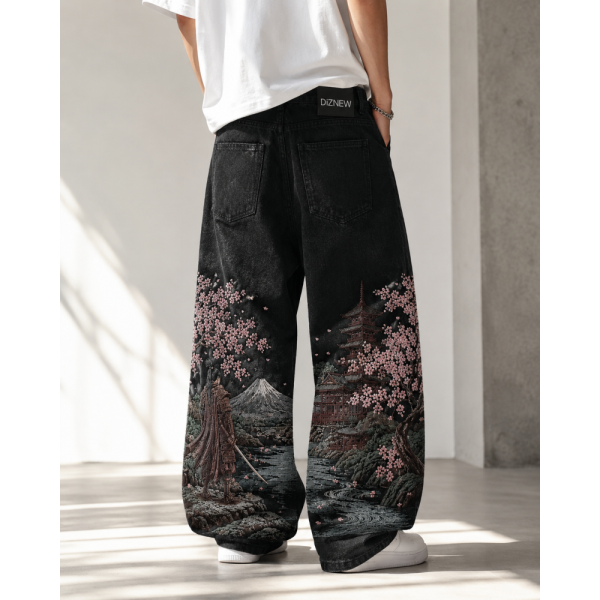
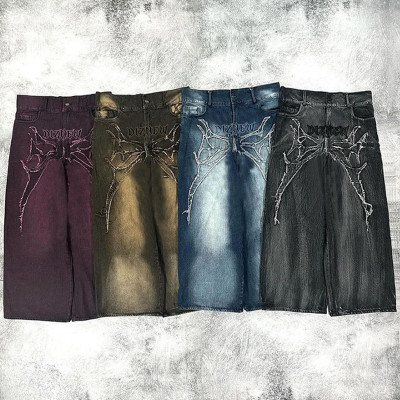
Premium wide-leg denim jeans featuring a vintage washed black finish, detailed Japanese landscape artwork, embroidery-style decoration, and custom brand label options. Designed for streetwear brands, designer labels, and private label collections looking for statement denim with strong visual storytelling.
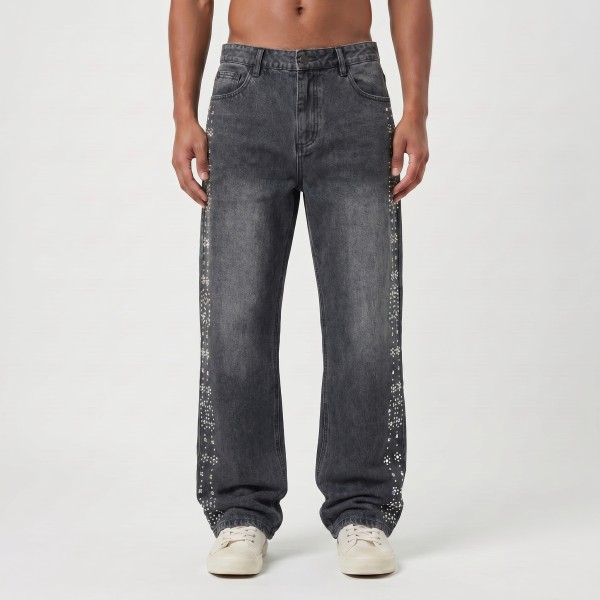
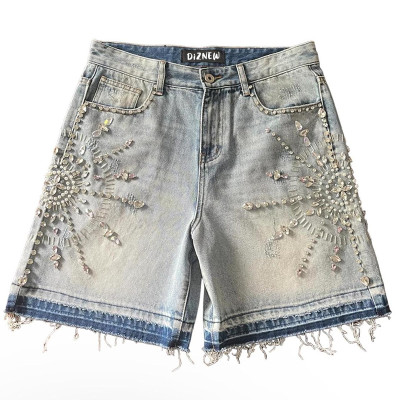
Discover premium DiZNEW denim jeans with decorative studs for a sparkling, stylish look. Order today!
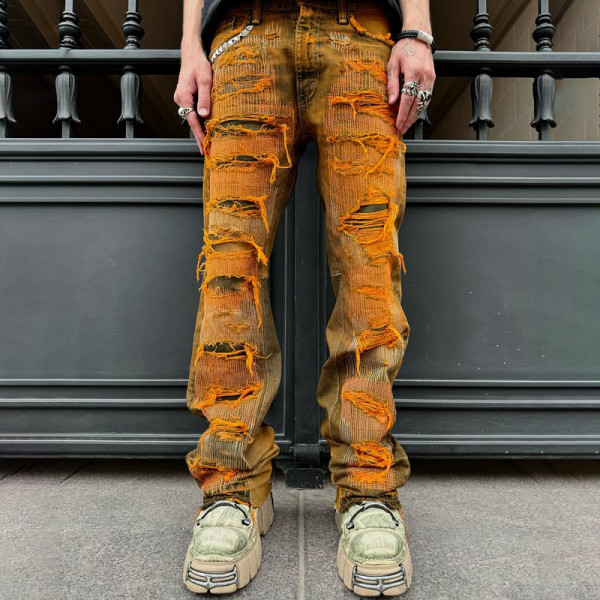
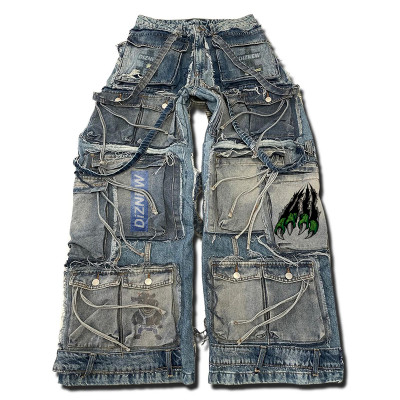
Discover Custom OEM/ODM Mud Yellow Distressed Jeans designed for brands and wholesalers, blending style with top-notch craftsmanship.
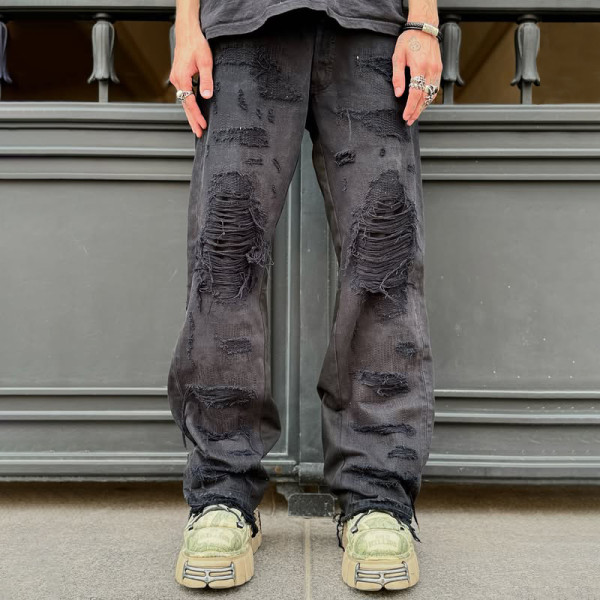
Wholesale Custom Loose Fit Distressed Grey Denim Jeans - Premium OEM/ODM services for tailored styles that fit your brand.