Top custom jeans manufacturer?
The top custom jeans manufacturer is not always the factory with the largest building, the lowest quotation, or the longest customer list. For a denim brand, the better question is practical. Can the manufacturer understand your design, develop the intended fit, reproduce the approved wash, and deliver consistent products at a quantity your business can actually sell?
Denim makes that decision harder than it first appears. Fabric weight affects drape. Washing changes color and measurements. Distressing can reduce fabric strength. Stretch jeans may feel comfortable during fitting but lose their shape after repeated wear. A good product depends on coordination between fabric sourcing, patternmaking, sewing, washing, testing, and inspection.
The top custom jeans manufacturer combines denim-specific experience, accurate sampling, flexible order quantities, measurable quality control, and enough capacity to support growth. For an emerging brand, the right supplier should accept trial orders, develop products from sketches or tech packs, provide OEM or ODM services, customize branding, and reproduce the approved sample consistently when the order becomes larger.
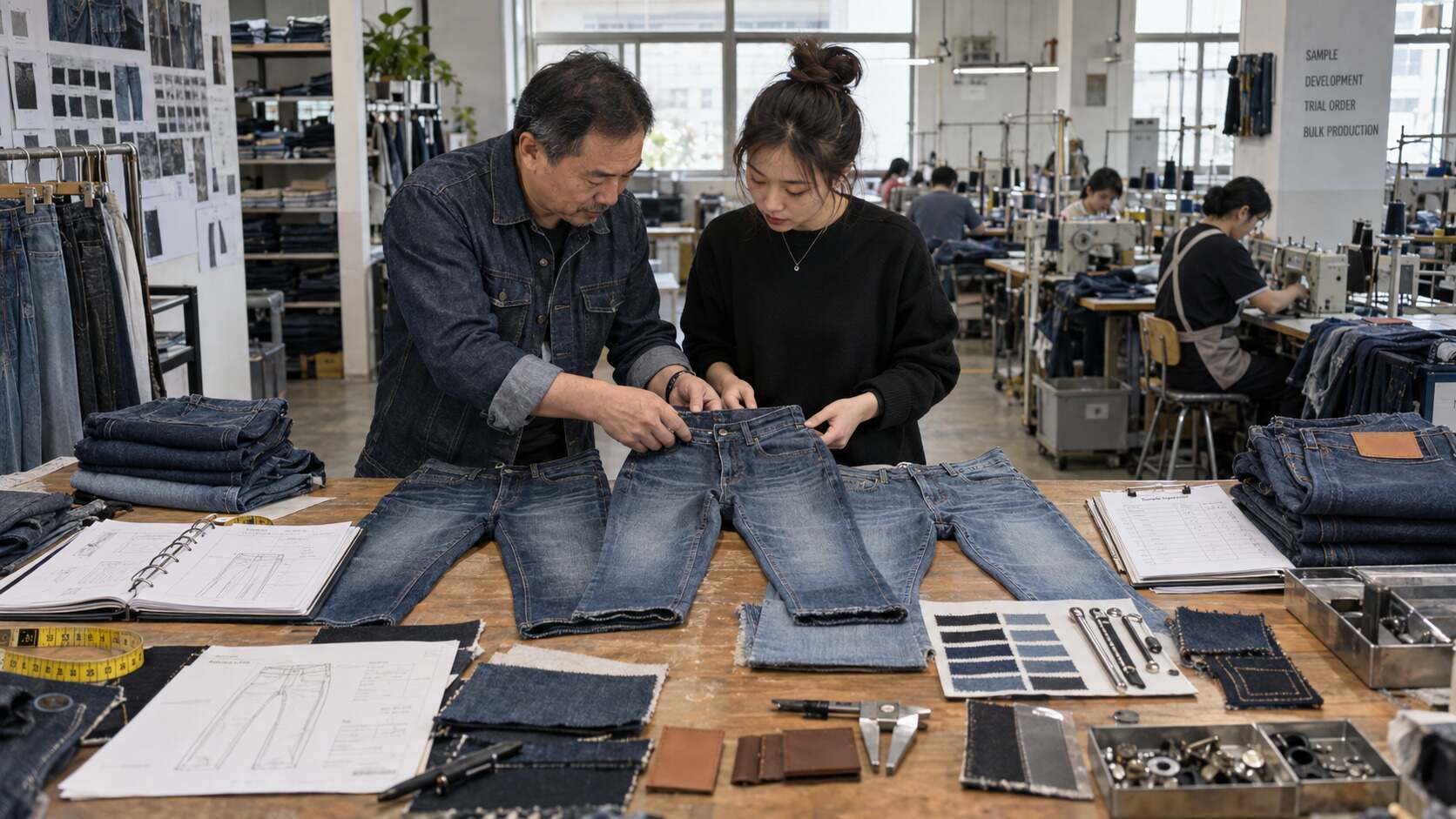
Imagine receiving two samples. One comes from an enormous supplier, but the fit feels generic and the wash misses your reference. The other captures the rise, leg shape, fading, pocket position, and stitching you pictured. Your customers will never ask which factory was larger. They will notice which jeans fit well, look good online, and still hold their shape after washing.
What Should You Look for in a Top Custom Jeans Manufacturer?
A top custom jeans manufacturer should demonstrate denim-specific experience, accurate product development, reliable quality control, and production capacity suited to your order. Review comparable samples, technical knowledge, communication, inspection procedures, and pricing transparency. The best supplier is one that can repeatedly deliver your approved design at the agreed quality, quantity, cost, and deadline.
Who Are the Best Jeans Manufacturers?
There is no universal ranking of jeans manufacturers because factories serve different markets. A large supplier may be excellent at producing basic five-pocket jeans in very high volumes. A smaller specialist may be better at complex washes, streetwear silhouettes, premium selvedge construction, plus-size development, or flexible private-label production.
Start with the product you want to sell. Rigid selvedge jeans require different fabric and sewing knowledge from highly elastic plus-size jeans. Baggy jeans depend on controlled volume through the rise, hip, and leg. Stacked jeans need enough length to form intentional folds without making the lower leg look shapeless. Heavily distressed denim needs careful testing because grinding, bleaching, and chemical treatments may weaken the garment.
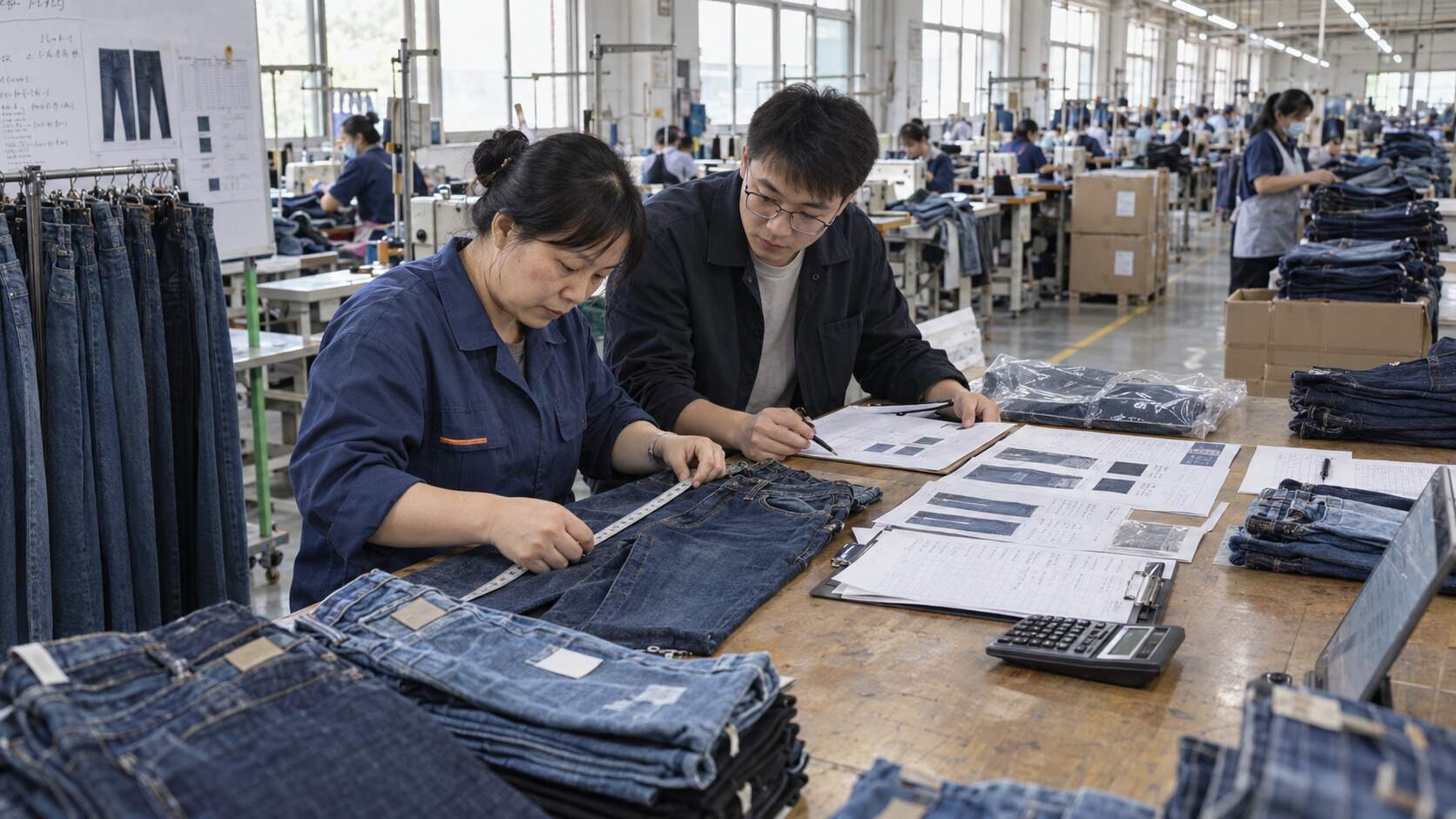
Ask potential suppliers to show recent products similar to your design. Examine the fabric, seams, wash consistency, pocket symmetry, trim attachment, and inside finishing. Product photos can help you screen factories, but a physical sample gives you much stronger evidence.
How Can You Compare a Factory’s Technical Capabilities?
Send the same product brief to several manufacturers and compare the questions they ask. An experienced denim developer should ask about the target customer, finished measurements, fabric composition, fabric weight, wash reference, stitching, hardware, size range, packaging, and target price.
A factory that quotes immediately from one photograph may be estimating a generic product. A supplier that points out missing measurements or warns that a wash could affect stretch recovery is already helping you manage risk.
Use a paid development sample as a practical test. Evaluate how closely the sample follows your design, how clearly the team communicates, and how it handles corrections. A capable factory may challenge a request when the chosen fabric or wash creates a technical problem. That kind of honest advice can prevent an expensive bulk-production mistake.
Does the Manufacturer Offer OEM, ODM, and Private-Label Services?
OEM production suits brands with a complete tech pack, measurement chart, material specification, artwork, and construction instructions. The manufacturer follows those documents and produces the garment under the customer’s label.
ODM support is useful when the design still needs technical development. The customer may provide sketches, photographs, or a reference garment, while the factory helps develop patterns, choose fabrics, create washes, and revise the fit.
Private-label services add brand elements such as woven labels, care labels, buttons, rivets, patches, hangtags, pocket bags, and packaging. Ask whether these components have separate minimum quantities. A factory may accept 30 garments while a custom button supplier requires several hundred buttons.
Before placing an order, request business information, production details, relevant compliance documents, comparable samples, and an explanation of the factory’s quality-control process. Certificates support due diligence, while the approved product sample remains the clearest evidence of what the factory can make for your brand.
Can a Custom Jeans Manufacturer Turn Your Design Sketches into Finished Products?
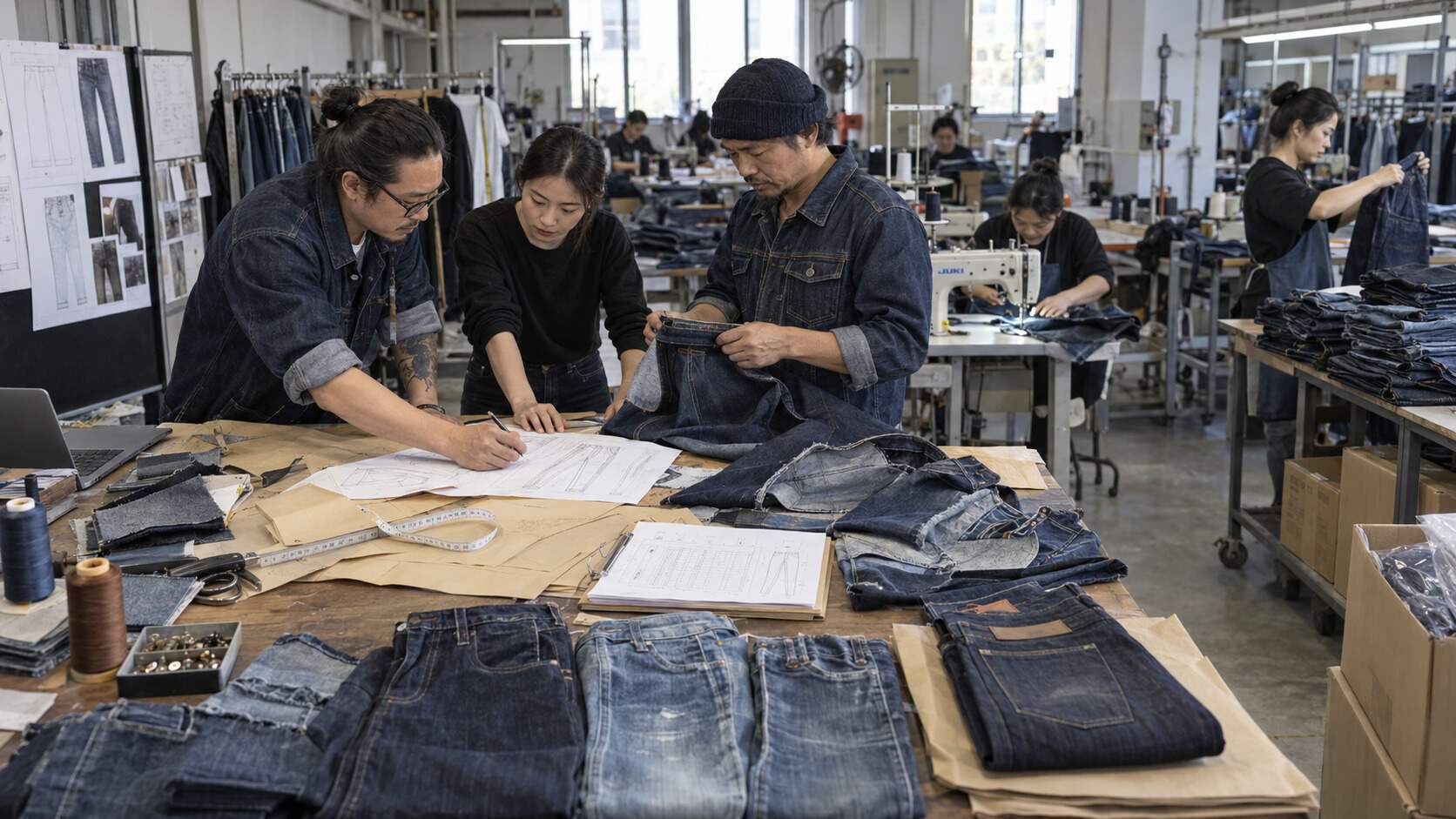
Yes. A capable custom jeans manufacturer can convert a sketch, photograph, reference garment, measurement chart, or tech pack into a finished product. The process normally covers design review, fabric selection, patternmaking, sample sewing, washing, fitting, revisions, pre-production approval, bulk manufacturing, inspection, and packing.
Which Brand Makes the Best Custom-Made Jeans?
Retail brands and custom manufacturers perform different jobs. A consumer brand develops jeans for its own audience. A custom manufacturer must build products around another company’s design language, target customer, price point, sizing, and sales channel.
The best custom-made jeans are therefore the ones that meet your specifications and work for your customer. Heavy raw denim may be perfect for an enthusiast brand but unsuitable for a boutique whose customers want soft stretch and easy movement. An exaggerated baggy sample may look exciting in campaign photos but disappoint buyers if the waist and rise feel uncomfortable.
Judge a manufacturer through a real development project. Give the factory a clear brief and order a sample. That sample will show whether the team understood the silhouette, proportions, fabric, wash, and construction.
How Does a Sketch Become a Production-Ready Sample?
A sketch communicates the visual direction, but a factory needs measurable instructions. The development team must define the rise, hip, thigh, knee, inseam, leg opening, pocket dimensions, seam construction, and stitch placement.
A useful tech pack should cover the following areas.
| Development item | Information to provide |
| Design | Front and back drawings or clear references |
| Measurements | Finished garment specifications by size |
| Fabric | Composition, weight, stretch, color, and hand feel |
Wash | Reference image, wash panel, or approved garment |
Construction | Seams, stitching, pockets, waistband, and closure |
Branding | Labels, buttons, rivets, patches, and artwork |
Packing | Hangtags, folding, polybags, and cartons |
When no complete tech pack exists, an ODM-capable manufacturer can help define these details. The customer still needs to communicate the intended customer, fit, price level, and visual direction.
The first sample should be washed before the final fit is approved. Denim may shrink, twist, fade, soften, or relax during finishing. Patternmakers must allow for those changes.
Fit the sample on the correct body size or fit model. Plus-size jeans need attention to waistband shape, rise, hip curve, thigh room, pocket scale, and grading. Stacked jeans must be reviewed with suitable footwear. Baggy jeans should carry volume without losing balance around the seat and rise.
Put every revision into one comment sheet. “Make the leg looser” leaves room for interpretation. A revised thigh and leg-opening measurement, supported by a marked photograph, gives the patternmaker a clear instruction.
Complex distressing, embroidery, patchwork, coatings, or custom hardware should be tested before bulk production. Each additional process affects price, lead time, fabric performance, and consistency.
What Types of Custom Denim Products and Fits Can You Manufacture?
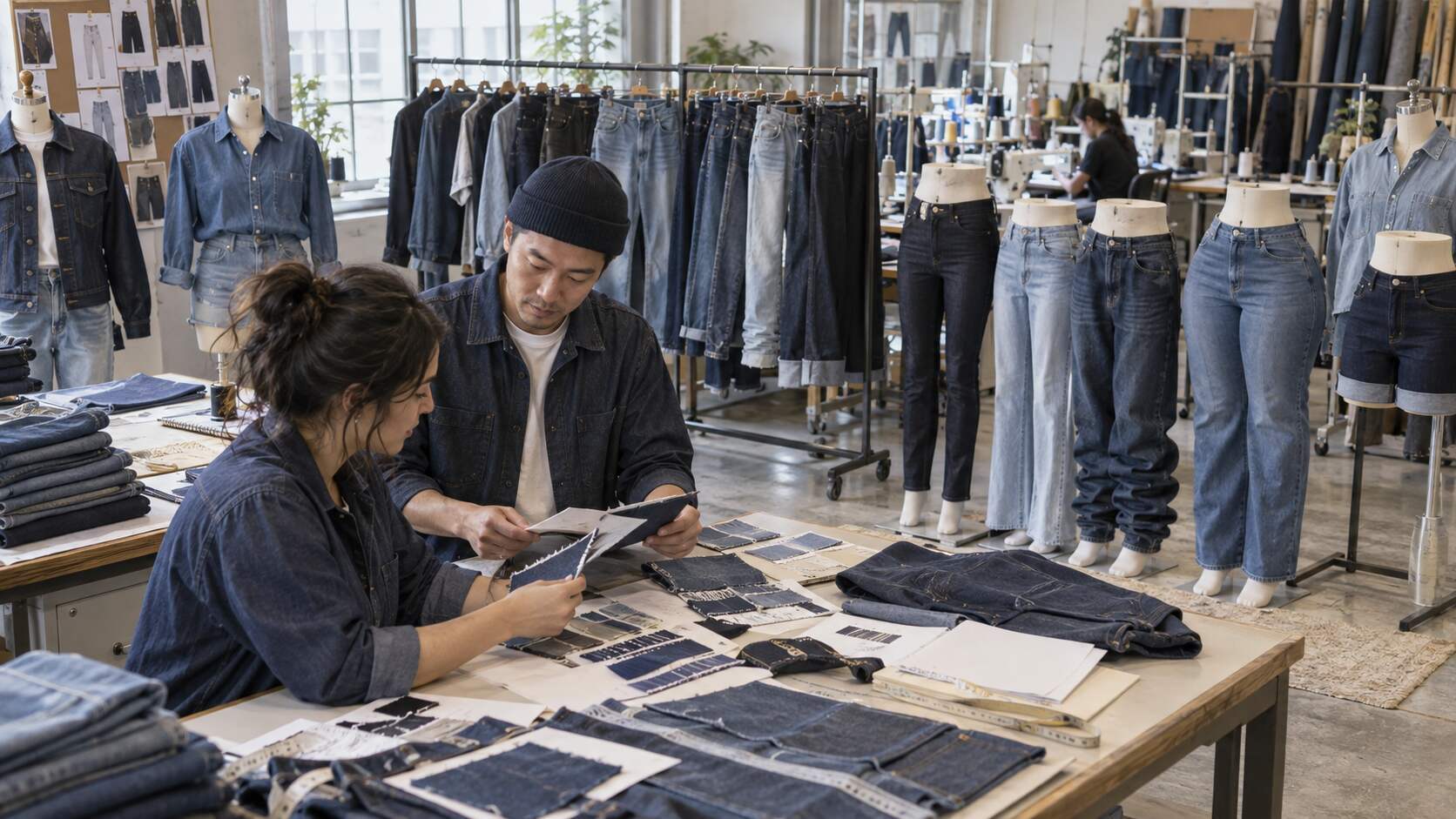
A versatile denim factory can produce skinny, straight, baggy, stacked, jogger, plus-size, and selvedge jeans, together with denim jackets, shorts, and shirts. The manufacturer should match fabric composition, weight, stretch, construction, and wash to the intended fit, customer, retail price, and use.
Which Brand Makes the Highest Quality Jeans?
No single jeans brand has the highest quality for every customer. Quality depends on the product’s purpose. Raw selvedge buyers may value dense fabric, traditional construction, and gradual fading. Customers buying stretch jeans may care more about comfort, shape recovery, size consistency, and easy care.
For custom manufacturing, quality should be translated into measurable standards. These may include finished measurements, dimensional stability, seam strength, stitch appearance, fabric weight, colorfastness, stretch recovery, zipper performance, wash shade, and workmanship.
AATCC publishes textile test methods covering areas such as crocking, accelerated laundering, garment dimensional change, fabric skew, and appearance after home washing. These methods help brands and manufacturers discuss performance with evidence. AATCC textile testing standards
What Defines High-Quality Denim Fabric and Construction?
Fiber composition alone does not determine quality. Two fabrics labeled 98 percent cotton and 2 percent elastane may behave very differently. Yarn quality, weave structure, finishing, stretch percentage, and recovery influence comfort and durability.
Rigid cotton denim provides structure and can develop distinctive wear patterns. Stretch denim improves movement, but weak recovery may leave the knees and seat baggy. Cotton Incorporated describes mechanical-stretch cotton constructions that can provide approximately 10 to 18 percent fill stretch, depending on fabric weight and weave. This illustrates why brands should review fabric performance rather than relying only on the fiber label. Cotton Incorporated technical guide
Construction quality includes secure seams, stable waistbands, clean topstitching, reinforced stress points, smooth zippers, and correctly positioned pockets. A fashionable wash cannot compensate for twisted legs, broken bartacks, or inconsistent measurements.
Which Jeans Fits Can Be Customized?
Skinny jeans need controlled stretch and recovery. Straight jeans rely on clean proportions from the hip through the leg opening. Baggy jeans require added volume while keeping the waist, seat, and rise balanced. Stacked jeans need extra length and the correct lower-leg shape to produce deliberate folds.
Plus-size jeans deserve their own fit development. Enlarging every measurement from a smaller pattern by the same percentage rarely produces a well-balanced garment. The patternmaker must consider waistband contour, front and back rise, hip shape, thigh room, pocket scale, and the amount added between sizes.
A denim specialist may also produce jackets, shorts, and shirts, though buyers should request category-specific samples. Jackets have different sleeve and movement requirements. Shirts often use lighter fabric and finer stitching. Shorts may need a different leg shape even when they begin with an existing jeans pattern.
Brand identity can be added through pocket stitching, embroidery, leather or vegan patches, jacron labels, buttons, rivets, zipper pulls, hangtags, pocket bags, and packaging. Choose details that customers will remember. Adding a logo to every component can make the product feel crowded.
What Are the MOQ, Cost, Lead Time, and Quality-Control Requirements?
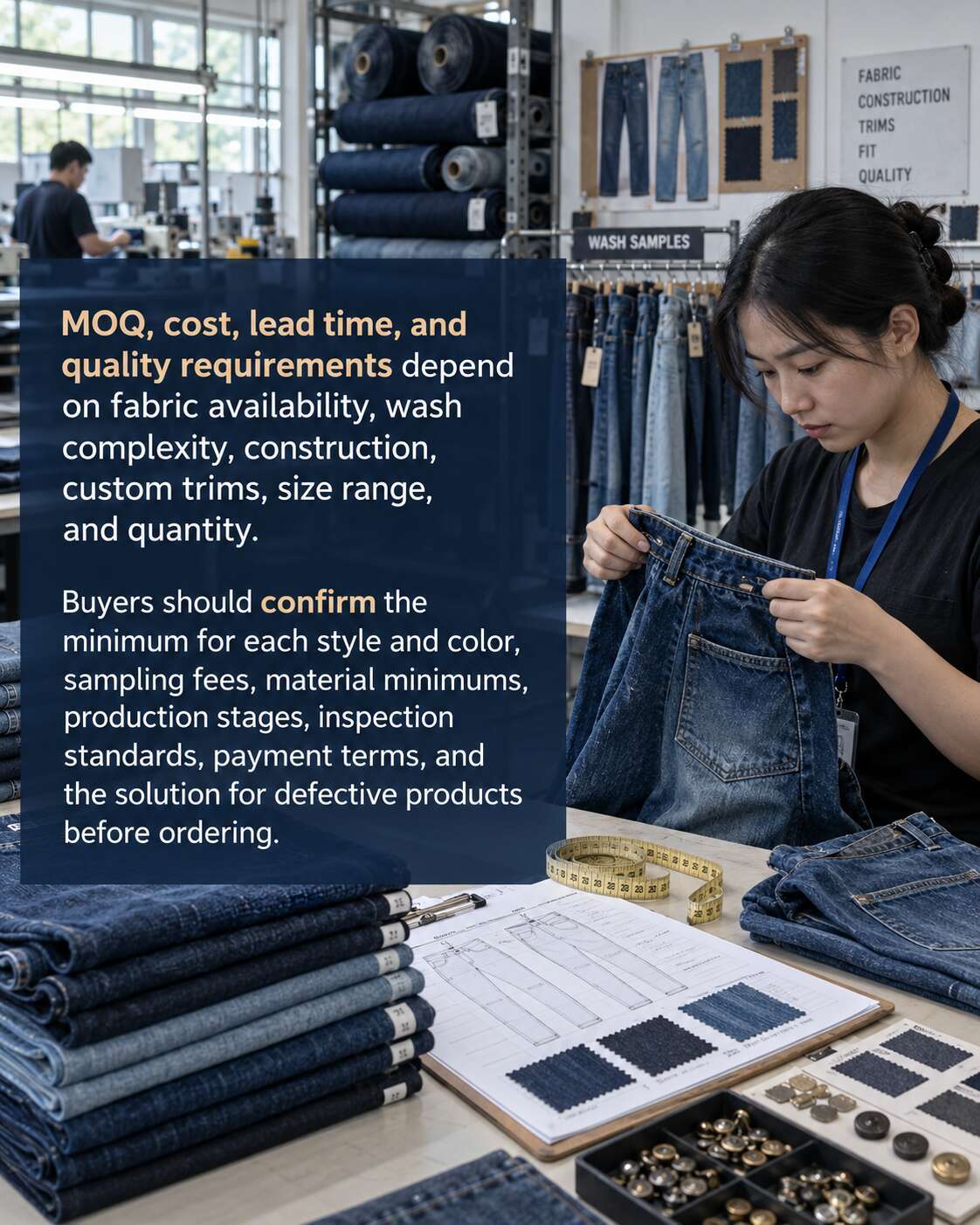
MOQ, cost, lead time, and quality requirements depend on fabric availability, wash complexity, construction, custom trims, size range, and quantity. Buyers should confirm the minimum for each style and color, sampling fees, material minimums, production stages, inspection standards, payment terms, and the solution for defective products before ordering.
Who Is the Largest Manufacturer of Jeans?
There is no simple answer because “manufacturer” may mean a brand owner, apparel group, factory network, exporter, or physical production facility. Levi Strauss & Co. is one of the world’s largest and most recognized denim companies. Wrangler and Lee are also major international brands. Large brands frequently use supplier networks, so company revenue does not identify one factory as the world’s largest jeans manufacturer. Levi Strauss annual reports
Scale can benefit a global retailer ordering large volumes of standardized products. It offers less value to a designer ordering 100 highly customized pieces. Very large suppliers may prioritize established accounts and long production runs. Smaller specialists may provide closer development support but have lower maximum capacity.
Choose a factory that can handle your current order carefully and support realistic growth. Your project should matter to the supplier without consuming more capacity than it can safely manage.
What Is a Reasonable MOQ for Custom Jeans?
MOQ can apply separately to the garment, fabric, wash, color, size assortment, trims, and packaging. Ask for a written breakdown instead of relying on one headline number.
DiZNEW starts custom jeans orders at 30 pieces and can support bulk orders reaching 10,000 pieces, according to the company information provided for this article. The final minimum depends on the fabric, wash, branding, and design complexity.
| Order factor | What buyers should confirm |
| Style MOQ | Minimum quantity for one pattern |
| Color or wash MOQ | Minimum for each finish |
| Size breakdown | Available sizes and minimum per size |
Custom trims | Separate minimums for buttons, patches, or labels |
Reorders | Ability to reproduce the fabric and wash |
A low MOQ helps a new brand test fit, photography, pricing, and customer demand without holding excessive inventory. The unit price will usually be higher because development and setup costs are divided across fewer garments.
What Determines Cost and Lead Time?
Fabric is a major cost, followed by sewing and finishing. Heavy distressing, embroidery, patchwork, coatings, special washes, and custom hardware increase labor and development risk. A broad size range may require more pattern work, fabric, and inspection.
Compare quotations using identical specifications and shipping terms. Check whether labels, packaging, testing, inspection, freight, and duties are included. A low unit price can become expensive once omitted items are added.
Ask for a timeline covering fabric sourcing, first sample, revisions, pre-production approval, bulk sewing, washing, inspection, and shipping. Leave room for sample corrections and material delays.
Quality control should begin with approved fabric, measurements, trims, wash references, and a sealed pre-production sample. During production, inspectors should check cutting, sewing, measurements, wash shade, workmanship, and packing.
Washed denim requires close attention to shrinkage, skew, shade variation, abrasion damage, and color transfer. Request measurement reports, wash-test results, and final inspection records. A statement that quality is good offers reassurance. A report showing what was checked provides evidence.
Why Should Designers and Boutique Owners Consider DiZNEW as Their Custom Jeans Manufacturer?
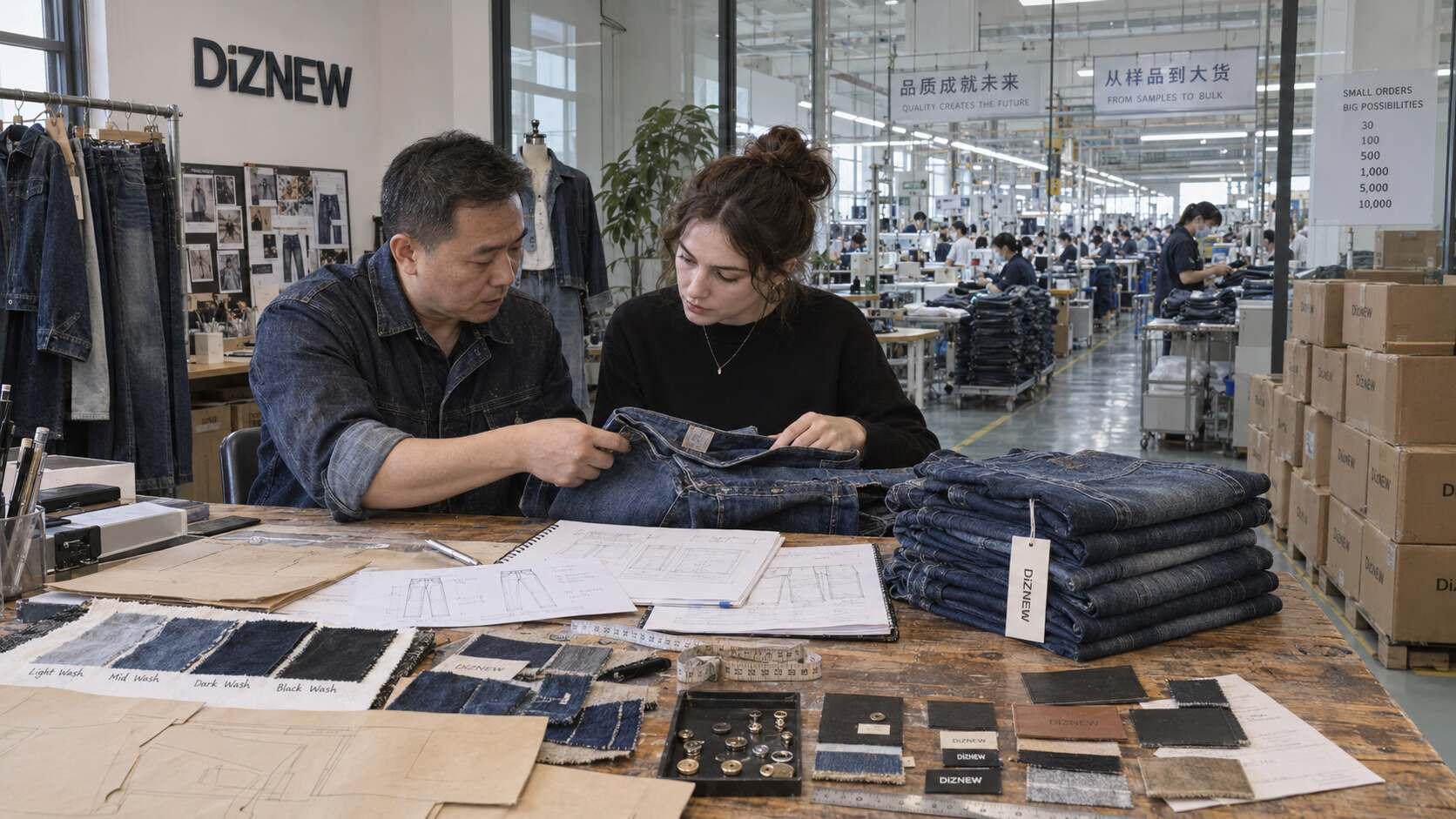
DiZNEW is a Chinese denim development and manufacturing company with more than 20 years of experience. It provides OEM, ODM, private-label, and deep customization services for designers, online boutiques, influencer-led stores, and established brands. Orders can start at 30 pieces and scale to 10,000 pieces, depending on the design and materials.
How Does DiZNEW’s Experience Benefit Buyers?
Denim experience becomes valuable when it prevents avoidable mistakes. Fabric, pattern, construction, and washing influence one another. A new wash can change measurements. A different fabric can alter the drape. Stronger distressing may weaken an area that carries body tension.
DiZNEW can work from a tech pack, design sketch, reference garment, or collection concept. Its services can include fabric selection, pattern development, sample production, fit revisions, wash development, branded trims, bulk manufacturing, and packing.
This support is useful for designers who know how the product should look but need technical help preparing it for production. It also serves boutique owners who want original denim products without maintaining an internal development department.
Can DiZNEW Support Trial Orders and Bulk Production?
DiZNEW’s 30-piece starting quantity allows brands to test a style before investing in a large inventory. A trial order can reveal how customers respond to the fit, wash, price, and product photography.
When a product performs well, production can grow toward 10,000 pieces. Scaling still requires accurate records. Keep the approved measurement chart, fabric information, wash standard, trim specifications, and sealed sample. These documents help the factory reproduce the product during reorders.
DiZNEW’s product range includes plus-size, baggy, stacked, straight, selvedge, skinny, and jogger jeans. The factory can also develop denim jackets, shorts, and shirts with customized fabrics, colors, washes, distressing, embroidery, labels, hardware, and packaging.
How Can You Start an OEM or ODM Project with DiZNEW?
Send DiZNEW your sketch, tech pack, reference sample, or product photographs. Include your target fit, size range, fabric preference, wash, branding details, quantity, destination market, target price, and expected delivery date.
Your first inquiry does not need to answer every technical question. It should give the development team enough information to understand the product and recommend the next step.
If you are building a denim collection, testing a signature jeans style, or looking for a flexible OEM or ODM partner, contact DiZNEW for a project review and quotation. Share your design and expected quantity through www.diznew.com. The team can discuss fabrics, sampling, MOQ, pricing, production, branding, and how to turn your idea into a finished denim product.
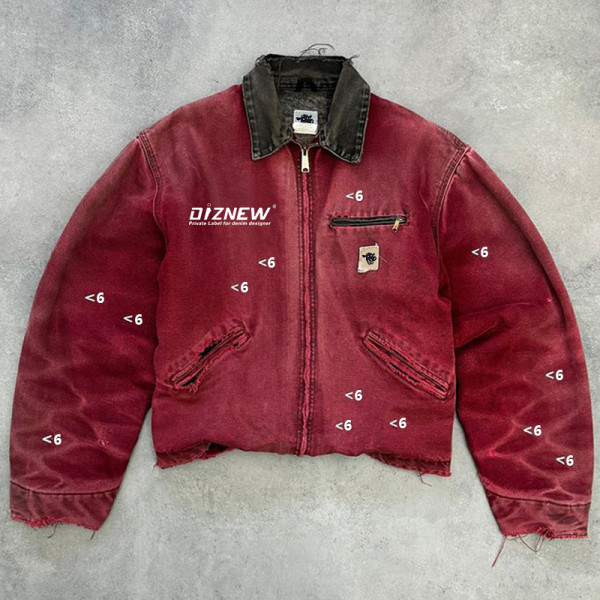
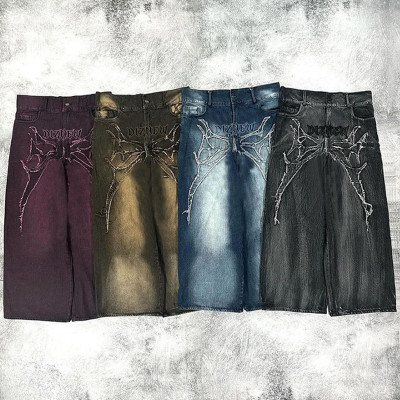
Discover this unique washed red canvas jacket featuring distressed details and vintage workwear aesthetics, perfect for bold fashion statements.
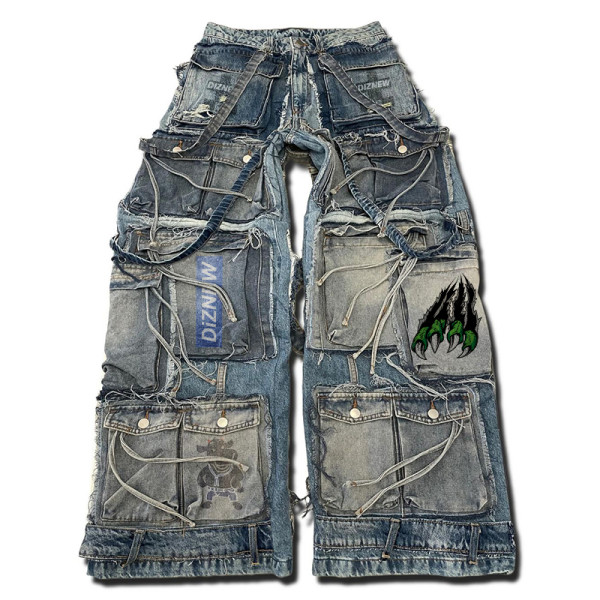
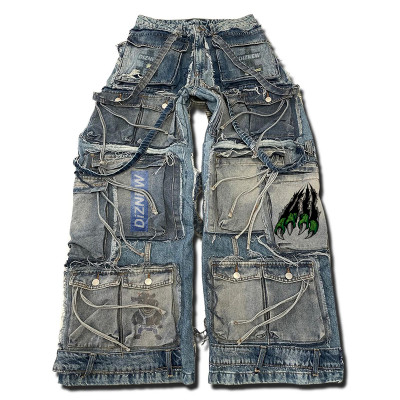
Washed denim cargo jeans with raw edge detail and oversized pockets for a bold streetwear look.
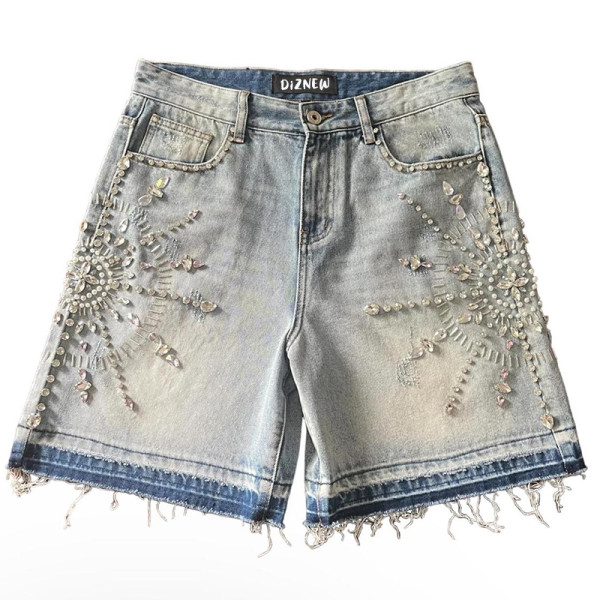
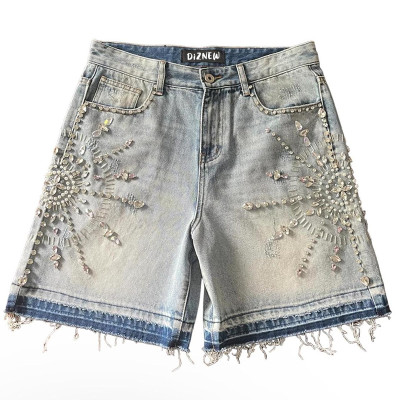
Custom Blue denim shorts with crystal detailing, blending luxury and street style. Stand out with this personalized denim design.